The Cold War did not begin with a single shot or declaration. It emerged gradually from the ashes of World War II, as the Grand Alliance against Germany disintegrated into bitter rivalry.
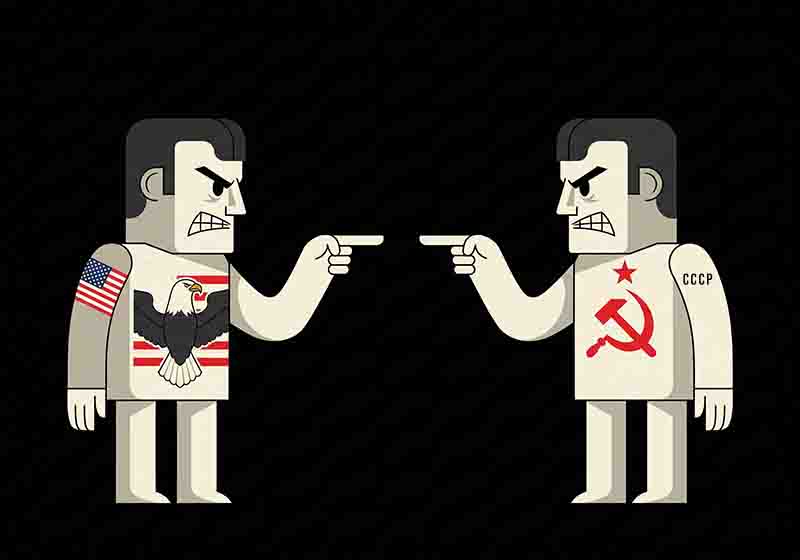
The conflict began as both powers sought to expand their influence. The U.S. pursued a policy of containment to stop the spread of communism, while the Soviet Union established control over Eastern Europe.
In just two years, from February 1945 to March 1947, the United States and Soviet Union transformed from partners in victory into leaders of opposing global blocs.
This article examines the critical moments that created the Cold War: the conferences where trust broke down, the speeches that defined new doctrines, and the policies that institutionalized confrontation. Understanding these origins is essential for comprehending the four decades of conflict that followed.
Key Concept: The Security Dilemma
The Cold War's origins illustrate the "security dilemma" in international relations: actions taken by one state for defensive purposes (Soviet control of Eastern Europe) appear as offensive threats to another (the United States), triggering countermeasures (NATO) that confirm the original state's fears.
Yalta Conference: The High Water Mark (February 4-11, 1945)
The Yalta Conference on the Crimean Peninsula represented the final meeting of the "Big Three", Winston Churchill, Franklin D. Roosevelt, and Joseph Stalin. The setting itself carried symbolic weight: the Livadia Palace, last residence of Tsar Nicholas II before the Russian Revolution, now hosted leaders discussing Europe's postwar future.
Agreements at Yalta
The conference produced several key agreements that would shape the postwar order:
United Nations: Stalin agreed to Soviet participation in the new international organization, including membership on the Security Council.
Germany: Agreement on unconditional surrender, occupation zones, and denazification.
Poland: The most contentious issue, Stalin insisted on a pro-Soviet government, while Roosevelt and Churchill pushed for free elections.
Far East: Secret agreement for Soviet entry into the war against Japan within three months of Germany's defeat.
"It is permitted to hope that the three great powers, which have increased their mutual trust during the severe war years, will maintain and strengthen this cooperation in the postwar period."
Seeds of Discord
Despite optimistic public statements, Yalta revealed fundamental disagreements. Roosevelt, gravely ill and focused on securing Soviet participation in the United Nations, made concessions on Eastern Europe that Churchill opposed. The "Declaration on Liberated Europe" promised free elections, but Stalin interpreted this loosely, guaranteeing pro-Soviet governments in Poland, Romania, and Bulgaria.
The atomic bomb, still under development, cast a shadow over proceedings. Roosevelt casually mentioned "a new weapon" to Stalin, who showed little reaction, Soviet intelligence had already penetrated the Manhattan Project. But the bomb's eventual use would fundamentally alter the superpower balance.
Potsdam Conference: The Breakdown (July 17 - August 2, 1945)
By the time the "Big Three" met again at Potsdam, the context had transformed completely. Germany had surrendered. Roosevelt had died on April 12, succeeded by the less diplomatic Harry S. Truman. Churchill attended the opening sessions but was replaced by Clement Attlee on July 28 after losing the British general election.
New Leaders, New Tensions
Truman, who had been Vice President for only 82 days before Roosevelt's death, approached Soviet relations with a harder edge than his predecessor. On July 16, the day before the conference opened, American scientists successfully tested the first atomic bomb at Alamogordo, New Mexico. Truman received news of the "Trinity" test during the conference, strengthening his negotiating position.
"I got very well acquainted with Joe Stalin, and I like old Joe! He is a decent fellow. But Joe is a prisoner of the Politburo".
The Potsdam Agreements
The conference produced the Potsdam Agreement governing Germany's occupation:
Division into four zones (American, British, French, Soviet)
Berlin, deep inside the Soviet zone, would also be divided
Demilitarization, denazification, democratization, and decartelization ("4 Ds")
Soviet reparations from their zone and 25% of industrial equipment from western zones
But disagreements festered beneath the surface. Truman resisted Soviet demands for massive reparations that would cripple German recovery. Stalin insisted on pro-Soviet governments in Eastern Europe. The "percentages agreement" Churchill had negotiated with Stalin in 1944, dividing spheres of influence in the Balkans, was never acknowledged by Truman.
The Atomic Shadow
Truman casually mentioned to Stalin that the United States possessed "a new weapon of unusual destructive force." Stalin, who knew of the bomb through espionage, showed little reaction. But the atomic attacks on Hiroshima and Nagasaki on August 6 and 9, while the conference was technically still in session, profoundly shaped Soviet security calculations.
Soviet Perspective
From Moscow's viewpoint, the atomic bomb represented an existential threat. The United States had demonstrated willingness to use nuclear weapons against civilian populations and refused to share atomic secrets through the proposed Baruch Plan. Soviet leaders concluded that only possessing their own bomb could ensure security against American nuclear blackmail.
The Long Telegram: Defining the Enemy (February 1946)
On February 22, 1946, George F. Kennan, the 42-year-old chargé d'affaires at the American embassy in Moscow, sent an 8,000-word telegram to Washington that would define American Cold War strategy. Responding to a routine Treasury Department query about why the Soviets were blocking international financial institutions, Kennan produced the most influential single document of the Cold War's origins.
Kennan's Analysis
The "Long Telegram" argued that Soviet behavior was not primarily responsive to Western actions but driven by internal ideological and historical necessities:
"At the bottom of the Kremlin's neurotic view of world affairs is the traditional and instinctive Russian sense of insecurity... Russian rulers have invariably sensed that their rule was relatively archaic in form, fragile and artificial in its psychological foundation, unable to stand comparison or contact with the political systems of Western countries."
Kennan identified several key sources of Soviet conduct:
Ideological imperative: Marxist-Leninist belief in the inevitable conflict between capitalism and socialism
Historical insecurity: Russia's vulnerability to invasion and desire for territorial buffers
Regime legitimation: The need for external enemies to justify domestic repression
Expansionist opportunism: Exploiting weaknesses in the capitalist world
The Containment Strategy
Kennan's solution, later elaborated in his 1947 "X Article" in Foreign Affairs was containment:
Containment Doctrine
"The main element of any United States policy toward the Soviet Union must be that of a long-term, patient but firm and vigilant containment of Russian expansive tendencies... Soviet pressure against the free institutions of the Western world is something that can be contained by the adroit and vigilant application of counterforce at a series of constantly shifting geographical and political points."
Crucially, Kennan believed that Soviet expansionism could be "contained" without general war. He argued that the Soviet system contained internal contradictions that would eventually cause its collapse if prevented from expanding. This patient, long-term strategy contrasted with more aggressive "rollback" approaches advocated by some Republicans.
Churchill's Iron Curtain Speech (March 5, 1946)
Less than two weeks after Kennan's Long Telegram, Winston Churchill delivered his famous "Sinews of Peace" address at Westminster College in Fulton, Missouri. With President Truman on the platform beside him, the former Prime Minister issued a clarion call that publicly defined the emerging division of Europe.
"From Stettin in the Baltic to Trieste in the Adriatic, an iron curtain has descended across the continent. Behind that line lie all the capitals of the ancient states of Central and Eastern Europe. Warsaw, Berlin, Prague, Vienna, Budapest, Belgrade, Bucharest and Sofia; all these famous cities and the populations around them lie in what I must call the Soviet sphere, and all are subject, in one form or another, not only to Soviet influence but to a very high and in some cases increasing measure of control from Moscow."
Reception and Impact
Churchill's speech was controversial. Former Vice President Henry Wallace condemned it as a call to war. The New York Times initially criticized its confrontational tone. But the "Iron Curtain" metaphor, borrowed from Joseph Goebbels's propaganda, captured the public imagination and entered permanent usage.
The speech signaled a fundamental shift in Western policy. Churchill explicitly called for a "fraternal association of the English-speaking peoples", a military alliance between the United States, British Commonwealth, and (implicitly) Western Europe against Soviet expansion. This was the intellectual foundation for NATO.
Soviet Reaction
Stalin responded personally in an interview with Pravda on March 14, 1946. He denounced Churchill as a "warmonger" and defender of British imperialism, comparing him to Hitler in his racial theories of Anglo-Saxon superiority. Stalin insisted that Soviet influence in Eastern Europe was necessary for security and had been agreed upon at Yalta and Potsdam.
The Truman Doctrine: Containment Becomes Policy (March 12, 1947)
The Truman Doctrine transformed Kennan's theoretical containment into official American policy. On March 12, 1947, President Truman addressed a joint session of Congress to request $400 million in aid for Greece and Turkey, nations facing communist insurgency and Soviet pressure.
The Greek Crisis
Britain had supported the Greek government against communist-led insurgents since 1944, but the collapsing British economy forced London to announce on February 21, 1947, that aid would end within six weeks. This "scissors crisis", the simultaneous expansion of Soviet power and contraction of British influence, created an vacuum that Washington felt compelled to fill.
"I believe that it must be the policy of the United States to support free peoples who are resisting attempted subjugation by armed minorities or by outside pressures. I believe that we must assist free peoples to work out their own destinies in their own way."
Global Implications
Truman's speech framed the conflict in stark ideological terms, freedom versus totalitarianism, that would define American Cold War rhetoric for decades. The request for Greece and Turkey became a universal principle applicable worldwide. As Senator Arthur Vandenberg advised Truman: "Mr. President, the only way you are going to get what you want is to make a speech and scare the hell out of the country."
Congress approved the aid, and the Truman Doctrine became the cornerstone of American foreign policy. It established the precedent that the United States would intervene globally against communist expansion, a dramatic departure from traditional American isolationism.
The Marshall Plan: Economic Weapons (June 5, 1947)
Less than three months after the Truman Doctrine, Secretary of State George C. Marshall announced a far more ambitious program at Harvard University's commencement. The European Recovery Program, universally known as the Marshall Plan, offered American economic aid to rebuild war-torn Europe, with profound political implications.
Marshall's Proposal
Marshall's speech was deliberately vague on details, inviting European nations to develop their own recovery plans. But the Secretary made clear that this was not merely humanitarian aid:
"Our policy is directed not against any country or doctrine but against hunger, poverty, desperation, and chaos. Its purpose should be the revival of a working economy in the world so as to permit the emergence of political and social conditions in which free institutions can exist."
The Soviet Response
Foreign Minister Vyacheslav Molotov initially showed interest, bringing an 89-person delegation to the Paris conference in June 1947. But Soviet leaders concluded that American aid would require opening their economy to Western inspection and influence, unacceptable conditions for a totalitarian regime. In July, Molotov walked out, denouncing the plan as an American scheme to dominate Europe.
The Soviet Union then prevented Czechoslovakia, Poland, and other Eastern European states from participating. This division—Western Europe accepting American aid, Eastern Europe refusing it, hardened the continent's split. The Cominform (Communist Information Bureau), established in September 1947, formally united communist parties under Soviet direction.
Scale and Impact
Between 1948 and 1952, the United States provided $13.3 billion (approximately $150 billion in 2024 dollars) to 16 Western European nations. The aid required recipients to reduce trade barriers, adopt market-oriented policies, and cooperate with each other, creating the economic foundation for European integration.
Economic vs. Military Containment
The Marshall Plan represented "economic containment", strengthening Western European societies against communist appeal through prosperity rather than military force. This complemented the "military containment" of the Truman Doctrine, creating a comprehensive strategy.
Origins Timeline: 1945-1947
Yalta Conference
Roosevelt, Churchill, and Stalin agree on postwar occupation zones and United Nations structure, but disagree on Poland's future.
Death of Franklin D. Roosevelt
Harry S. Truman becomes President, bringing a harder line toward Soviet expansion.
German Surrender (VE Day)
Common enemy defeated; Grand Alliance begins to fracture without unifying purpose.
Trinity Test
First atomic bomb successfully tested in New Mexico, altering the balance of power.
Potsdam Conference
Truman, Stalin, and Attlee (replacing Churchill) negotiate Germany's fate amid growing mistrust.
Atomic Bombs on Japan
Hiroshima and Nagasaki destroyed; Stalin accelerates Soviet nuclear program.
Long Telegram
George F. Kennan sends 8,000-word analysis from Moscow, proposing containment strategy.
Iron Curtain Speech
Winston Churchill declares that "an iron curtain has descended across the continent."
Clifford-Elsey Report
Top-secret White House study concludes Soviet expansionism requires firm American response.
Truman Doctrine
President Truman announces policy of supporting "free peoples" against communist subjugation.
Marshall Plan Announced
Secretary of State Marshall offers American aid for European recovery at Harvard.
Cominform Established
Soviet Union creates Communist Information Bureau to coordinate international communist parties.
Communist Takeover in Hungary
Soviet-backed communists eliminate opposition, establishing one-party rule.
12 Key Facts About the Cold War's Origins
Wartime Alliance: The US and USSR were allies for only 3 years and 9 months (June 1941-May 1945), shorter than their subsequent Cold War confrontation.
Yalta's Ambiguity: The "Declaration on Liberated Europe" promised free elections but used vague language that Stalin and the West interpreted differently.
Truman's Inexperience: Harry Truman had been Vice President for only 82 days before becoming President; he met Stalin for the first time at Potsdam.
Atomic Secrecy: The Soviet Union knew about the atomic bomb through espionage before Truman mentioned it to Stalin at Potsdam.
Churchill's Warning: Churchill sent Truman a "iron curtain" memo in May 1945—ten months before his famous speech.
Kennan's Length: The "Long Telegram" was 5,540 words, so long that it required multiple transmissions and annoyed the State Department telegraph staff.
Greek Civil War: The immediate trigger for the Truman Doctrine was Britain's inability to continue aid to Greece, announced just three weeks before Truman's speech.
Marshall's Audience: The Marshall Plan was announced at Harvard's commencement to a crowd that included few policymakers, most learned of it from newspaper reports.
Soviet Interest: Molotov initially brought 89 officials to Paris to discuss Marshall Plan participation before Stalin ordered withdrawal.
Czechoslovak Coup: The final communist takeover in Czechoslovakia (February 1948) occurred after the Marshall Plan was announced, accelerating Western European cooperation.
Public Opinion: In 1945, 54% of Americans believed the US could cooperate with the Soviet Union; by 1946, only 35% held this view.
Containment's Author: George Kennan later disavowed the militarized containment that emerged, believing he had advocated political and economic measures rather than military buildup.
Frequently Asked Questions
Continue Reading
← Previous
Next →
On This Page
Key Figures
- George F. Kennan — Architect of containment
- Harry S. Truman — US President (1945-1953)
- Joseph Stalin — Soviet General Secretary
- Winston Churchill — British Prime Minister
- George C. Marshall — US Secretary of State
- Vyacheslav Molotov — Soviet Foreign Minister
Related Articles
Download: Available 10.2.26
Get the complete origins timeline with primary source documents.
Origins Timeline PDF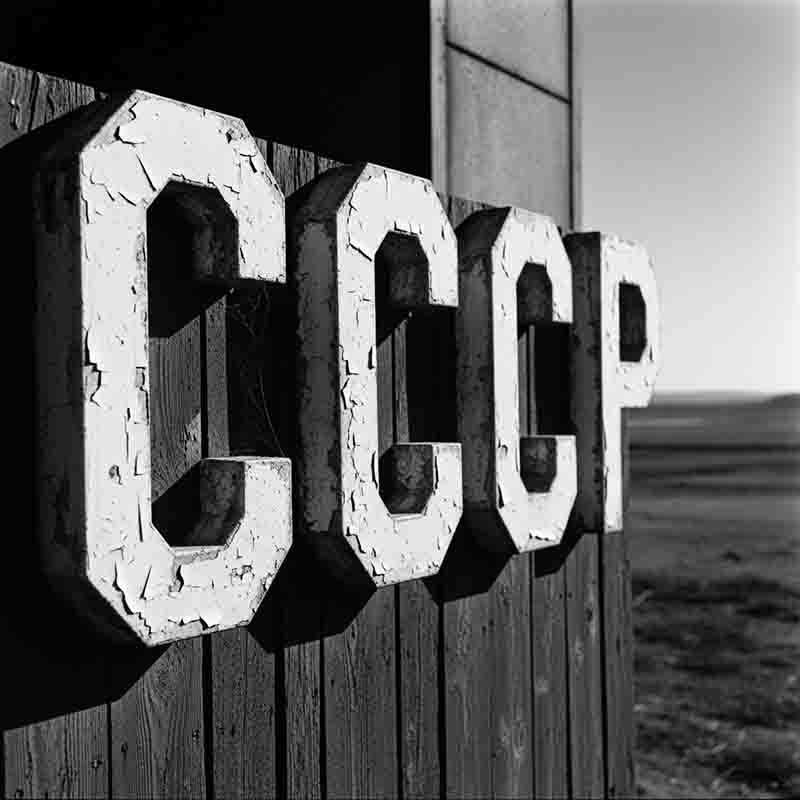
The abbreviation was widely used on official documents, currency, and state symbols of the Soviet Union.
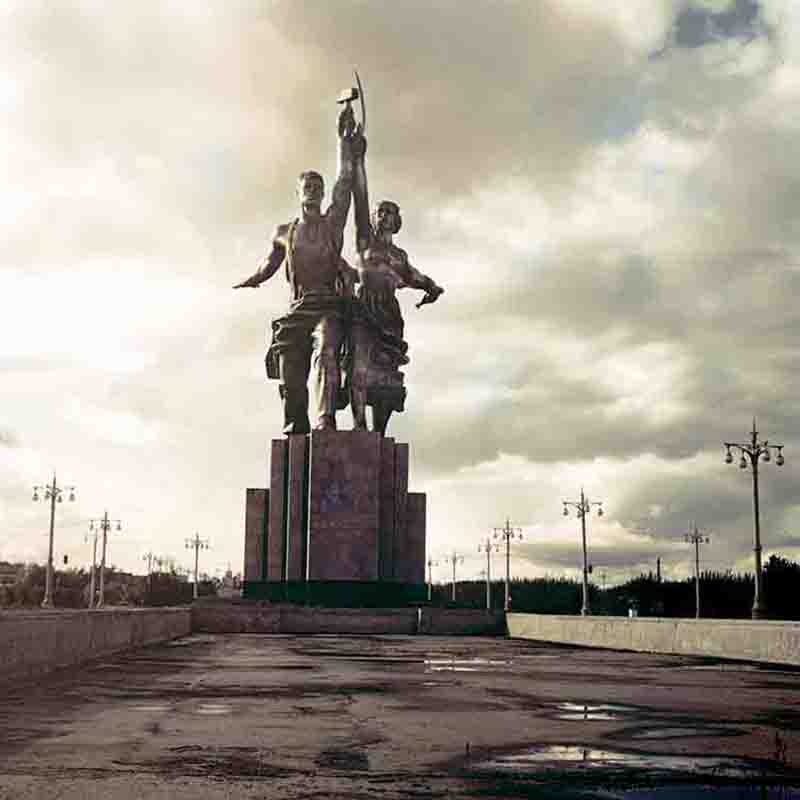
The iconic sculpture "Worker and Kolkhoz Woman", created by Vera Mukhina for the 1937 World's Fair in Paris.
About This Article
This article examines the origins of the Cold War from 1945-1947, tracing how wartime allies became bitter enemies. Part of the Cold War series on soviet-union.com.
Last Updated: February 8, 2026 | Reading Time: 15 minutes