The Manhattan Project was the codename for the American-led research and development program that produced the first atomic bomb.
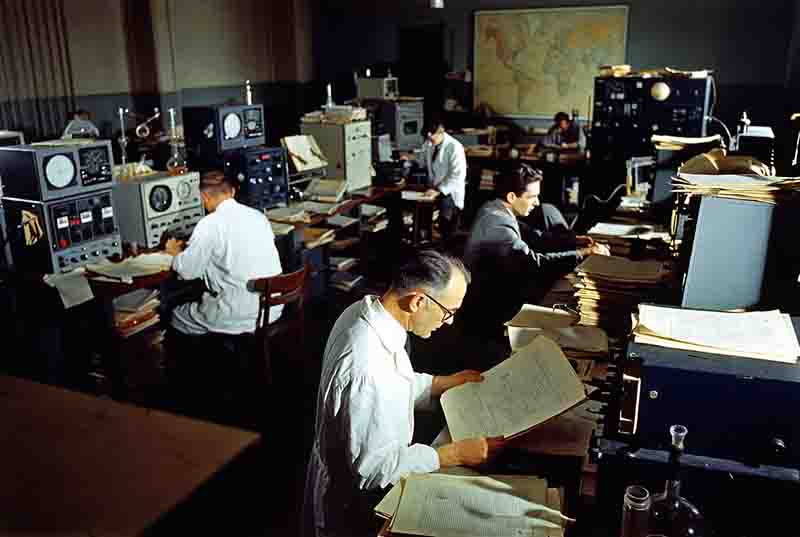
The Manhattan Project was an unprecedented R&D undertaking during World War II that focused on the weaponization of nuclear fission. Driven by the fear that Nazi Germany was developing similar technology, the project spanned multiple secret sites across the United States.
Initiated in 1942 under the shadow of Germany's rumored atomic program, it grew from a modest research effort into a massive industrial complex spanning the North American continent.
By the time the project concluded in 1947, it had employed 130,000 people, consumed $2 billion in funding (equivalent to roughly $30 billion today), and created a weapon that would fundamentally alter the nature of warfare and international relations. The project's legacy extends far beyond the bombs dropped on Hiroshima and Nagasaki, it established the infrastructure, scientific knowledge, and industrial capacity that would define the nuclear age.
Key Concept: Nuclear Fission
The Manhattan Project was based on the discovery of nuclear fission, the splitting of atomic nuclei to release enormous energy. First achieved in 1938 by German scientists Otto Hahn and Fritz Strassmann, fission offered the theoretical possibility of weapons thousands of times more powerful than conventional explosives. The project's challenge was transforming this theoretical possibility into functional weapons before Germany could do the same.
Origins and Early Development
The path to the Manhattan Project began with a letter. In August 1939, physicist Leo Szilard and Eugene Wigner visited Albert Einstein at his summer home on Long Island, carrying a draft letter to President Franklin D. Roosevelt. The letter warned that German scientists had discovered nuclear fission and that Nazi Germany might develop atomic weapons.
The Einstein Letter
Einstein's letter, delivered in October 1939, urged the President to support American research into atomic energy. Roosevelt responded cautiously, establishing the Uranium Committee with a modest $6,000 budget. Progress remained slow until 1941, when the British MAUD Committee concluded that an atomic bomb was feasible and could be built in time to affect the war's outcome.
"In the course of the last four months it has been made probable... that it may become possible to set up a nuclear chain reaction in a large mass of uranium, by which vast amounts of power and large quantities of new radium-like elements would be generated."
The Decision to Build
The American entry into World War II following Pearl Harbor transformed the atomic program's urgency. In December 1941, Vannevar Bush, head of the Office of Scientific Research and Development, presented a report to Roosevelt concluding that a bomb could be built. The President approved full-scale development in January 1942, and the Manhattan Engineer District was formally established in August 1942.
Why "Manhattan"?
The project was originally headquartered in Manhattan, New York, where much of the early research was coordinated. The Army Corps of Engineers designated it the "Manhattan Engineer District" following standard practice of naming projects after their headquarters city. The name stuck even as operations moved to Los Alamos, Oak Ridge, and Hanford.
Organization and Leadership
The Manhattan Project required unprecedented coordination between military, scientific, and industrial organizations. Its success depended on solving not just scientific problems but engineering, logistical, and security challenges on a massive scale.
Military Leadership: General Groves
In September 1942, Colonel Leslie R. Groves (soon promoted to Brigadier General) was appointed director of the project. Groves had just overseen the construction of the Pentagon and possessed the administrative skill and determination necessary for the massive undertaking. He controlled the project's budget, security, and construction, reporting directly to Army Chief of Staff General George Marshall and Secretary of War Henry Stimson.
General Leslie Groves
- • Military director 1942-1947
- • Oversaw construction
- • Managed security
- • Controlled $2B budget
- • Promoted to Major General
J. Robert Oppenheimer
- • Scientific director
- • Led Los Alamos lab
- • Recruited top scientists
- • Managed research teams
- • "Father of the atomic bomb"
Scientific Leadership: Oppenheimer
J. Robert Oppenheimer, a theoretical physicist from the University of California, Berkeley, was an unlikely choice to lead the weapons laboratory. He had no administrative experience, no Nobel Prize, and leftist political associations that concerned security officials. But Groves recognized his intellectual brilliance and ability to communicate across scientific disciplines. In October 1942, Oppenheimer was appointed director of the yet-to-be-built Los Alamos laboratory.
The Secret Cities
The Manhattan Project operated across a vast geographic area, with each site serving a specific function in the production of atomic weapons. These locations were chosen for their isolation, available resources, and security considerations.
Los Alamos: The Laboratory
The Los Alamos Laboratory in northern New Mexico was the project's scientific heart. Built on the site of a former boys' school, it housed the scientists and engineers responsible for designing and assembling the bombs. Under Oppenheimer's leadership, Los Alamos grew from a few buildings to a town of 6,000 residents, complete with housing, schools, and hospitals—all surrounded by barbed wire and armed guards.
"Los Alamos might have been any boomtown in the West. The difference was that this boomtown had the highest concentration of Nobel Prize winners in history, and everyone was working on a secret that could end the war—or end civilization."
Oak Ridge: The Secret City
Oak Ridge, Tennessee, was built from scratch in 1942 to enrich uranium for the bomb. The town grew to 75,000 residents without appearing on any map. Its factories employed thousands of workers operating calutrons (electromagnetic separation) and gaseous diffusion equipment, though most workers never knew what they were producing. By 1945, Oak Ridge was the fifth-largest city in Tennessee and consumed more electricity than New York City.
Hanford: Plutonium Production
The Hanford Site in Washington State produced plutonium-239 in three nuclear reactors built along the Columbia River. The reactors required massive amounts of water for cooling and generated radioactive waste that posed unprecedented disposal challenges. Hanford's B Reactor became the world's first full-scale nuclear reactor when it went critical in September 1944.
Chicago Pile-1
The world's first artificial nuclear reactor was built under the stands of Stagg Field at the University of Chicago. On December 2, 1942, Enrico Fermi and his team achieved the first self-sustaining nuclear chain reaction, proving that atomic energy could be controlled. The reactor was built in secret and operated at just 0.5 watts—barely enough to power a flashlight.
The Science of Destruction
The Manhattan Project had to solve fundamental scientific and engineering problems that had never been addressed before. The project pursued two different bomb designs simultaneously to maximize the chances of success.
Two Designs, Two Elements
The project developed two distinct types of atomic bombs. The gun-type design was simple and reliable but required rare uranium-235. The implosion design was complex but could use plutonium-239, which could be produced in reactors. The project pursued both approaches in parallel.
Little Boy
- • Uranium-235 gun-type
- • 9,700 pounds weight
- • 15 kilotons yield
- • Dropped on Hiroshima
- • Never tested before use
Fat Man
- • Plutonium implosion
- • 10,300 pounds weight
- • 21 kilotons yield
- • Dropped on Nagasaki
- • Tested at Trinity
The Implosion Problem
The implosion design presented the greatest challenge. It required symmetrically detonating conventional explosives to compress a plutonium sphere to supercritical density. The timing had to be precise to within nanoseconds. Solving this problem required new mathematical techniques, explosive lenses, and extensive testing. The challenge was so great that some scientists initially believed it impossible.
The Trinity Test
At 5:29:45 AM on July 16, 1945, the Trinity test ushered in the atomic age. The test of the plutonium implosion device—nicknamed "the Gadget" by its creators—took place at the Alamogordo Bombing Range in the Jornada del Muerto desert, 210 miles south of Los Alamos.
The Test
The Gadget was hoisted atop a 100-foot steel tower to simulate aerial detonation. Scientists and military officials observed from bunkers located 10,000 yards away. When the countdown reached zero, the explosion lit up the pre-dawn darkness with the brightness of multiple suns. The fireball expanded to 600 feet in diameter, and the mushroom cloud rose to 7.5 miles. The blast broke windows 120 miles away and was felt 160 miles distant.
"The whole country was lighted by a searing light with the intensity many times that of the midday sun. It was golden, purple, violet, gray, and blue. It lighted every peak, crevasse, and ridge of the nearby mountain range with a clarity and beauty that cannot be described but must be seen to be imagined."
Immediate Aftermath
The test yielded approximately 21 kilotons—more than expected. The steel tower vaporized, leaving only concrete footings. The desert sand fused into a radioactive green glass called "trinitite." General Groves, concerned about the test's success, first reported to Secretary Stimson that the "test was successful beyond expectation." The world had changed irrevocably.
The Code Name
The test was code-named "Trinity" by Oppenheimer, who later claimed inspiration from John Donne's poetry: "Batter my heart, three-person'd God." Some historians suggest the name referenced the Christian concept of the Trinity, reflecting the test's transformative significance. The site is now the White Sands Missile Range.
From Trinity to Combat
Less than a month after Trinity, the Manhattan Project's creations were used in combat. The bombings of Hiroshima and Nagasaki remain the only uses of nuclear weapons in warfare, killing approximately 200,000 people and demonstrating the atomic bomb's terrible power to the world.
Hiroshima: August 6, 1945
At 8:15 AM, the B-29 bomber Enola Gay dropped Little Boy on Hiroshima, a major industrial and military port. The bomb detonated 1,900 feet above the city, instantly killing 70,000-80,000 people. Tens of thousands more died from injuries and radiation sickness in the following months. The city's center was obliterated; fires raged for days.
Nagasaki: August 9, 1945
Three days later, Bockscar dropped Fat Man on Nagasaki. The original target was Kokura, but clouds obscured the city. Nagasaki, an industrial center and port, suffered similar devastation. Approximately 40,000 died immediately, with total deaths reaching 70,000 by year's end. Japan announced its surrender on August 15, 1945.
"We have discovered the most terrible bomb in the history of the world. It may be the fire destruction prophesied in the Euphrates Valley Era, after Noah and his fabulous Ark."
The Decision to Use the Bomb
The decision to use atomic weapons against Japan remains historically controversial. Proponents argue that it saved lives by avoiding a costly invasion of Japan. Critics contend that Japan was already seeking surrender terms, and that the bombings were unnecessary or primarily intended to demonstrate American power to the Soviet Union. The debate continues among historians today.
Legacy and Impact
The Manhattan Project's legacy extends far beyond the bombs that ended World War II. It established the infrastructure, scientific community, and industrial capacity that would define the nuclear age and the Cold War that followed.
The Nuclear Age
The project demonstrated that nuclear energy could be harnessed for both destruction and peaceful purposes. The same reactors that produced plutonium for bombs could generate electricity. The same scientific knowledge that created weapons could advance medicine, biology, and physics. The dual nature of nuclear technology—beneficial and destructive—has defined its history.
The National Laboratories
The Manhattan Project established the national laboratory system that continues today. Los Alamos, Oak Ridge, and Argonne (successor to the Chicago Metallurgical Laboratory) remain major research institutions. The project's model of large-scale, government-funded scientific research influenced everything from the space program to cancer research.
Cold War Origins
The Manhattan Project shaped the early Cold War in profound ways. The American nuclear monopoly (1945-1949) provided diplomatic leverage but also created anxiety about Soviet espionage—anxiety that was justified when Soviet spies were discovered in the project's ranks. The arms race that followed transformed international relations.
Manhattan Project Timeline: 1939-1947
Einstein Letter
Einstein and Szilard warn Roosevelt about German nuclear research, initiating American atomic program.
Acceleration
Pearl Harbor attack brings America into WWII; atomic program receives increased priority and funding.
Manhattan District
Colonel Leslie Groves appointed director; project formally established as Manhattan Engineer District.
First Chain Reaction
Enrico Fermi's team achieves first self-sustaining nuclear chain reaction at Chicago's Stagg Field.
Los Alamos Opens
Oppenheimer establishes laboratory at Los Alamos; scientists begin arriving to design the bomb.
Yalta Conference
Roosevelt, Churchill, and Stalin meet at Yalta; Truman later informs Stalin of "new weapon" at Potsdam.
Trinity Test
First atomic bomb successfully tested at Alamogordo, New Mexico; yields 21 kilotons.
Hiroshima
Little Boy dropped on Hiroshima; approximately 80,000 killed immediately.
Nagasaki
Fat Man dropped on Nagasaki; Japan announces surrender August 15.
Atomic Energy Commission
Manhattan Project formally replaced by Atomic Energy Commission; civilian control of atomic energy begins.
12 Key Facts About the Manhattan Project
130,000 Employees: At its peak, the project employed 130,000 people, making it one of the largest employers in America during the war.
$2 Billion Cost: The project cost approximately $2 billion (about $30 billion in 2024 dollars), more than any other weapons program of World War II.
Secret Cities: Oak Ridge, Tennessee grew from nothing to 75,000 residents without appearing on any map; workers there knew only their specific tasks.
Two Bomb Designs: The project developed both gun-type (Little Boy) and implosion-type (Fat Man) bombs simultaneously to maximize chances of success.
Trinity Test: The first atomic explosion at Alamogordo was so bright that a blind girl 50 miles away reported seeing the flash.
Einstein Excluded: Despite his letter initiating the program, Einstein was denied security clearance and never worked on the project due to pacifist views.
Women Scientists: The project included prominent women scientists including Leona Woods, Maria Goeppert Mayer, and Chien-Shiung Wu.
Plutonium Discovery: The element plutonium was first synthesized in 1940 and named after the dwarf planet Pluto (itself named for the Roman god of the underworld).
Security Breaches: Despite intense security, Soviet spies including Klaus Fuchs penetrated the project and passed atomic secrets to the USSR.
Medical Experiments: The project conducted secret human radiation experiments, including injecting plutonium into patients without their knowledge.
Environmental Legacy: The Hanford Site remains one of the most contaminated places in America, with 56 million gallons of radioactive waste stored in underground tanks.
Nobel Legacy: Los Alamos had the highest concentration of Nobel Prize winners in history, including Bohr, Fermi, Lawrence, and Chadwick.
— J. Robert Oppenheimer, 1947
Frequently Asked Questions
Continue Reading
← Previous
Next →
On This Page
Key Figures
- Leslie Groves — Military Director
- J. Robert Oppenheimer — Scientific Director
- Enrico Fermi — Chicago Pile-1
- Ernest Lawrence — Uranium Enrichment
- Leo Szilard — Chain Reaction
- Hans Bethe — Theoretical Physics
Key Events
- 1939: Einstein letter
- 1942: Project begins
- Dec 1942: Chain reaction
- July 1945: Trinity test
- Aug 1945: Hiroshima/Nagasaki
Related Articles
Download: Available 10.5.26
Get the complete Manhattan Project analysis with declassified documents. (Available 10.5.26)
Manhattan Project PDF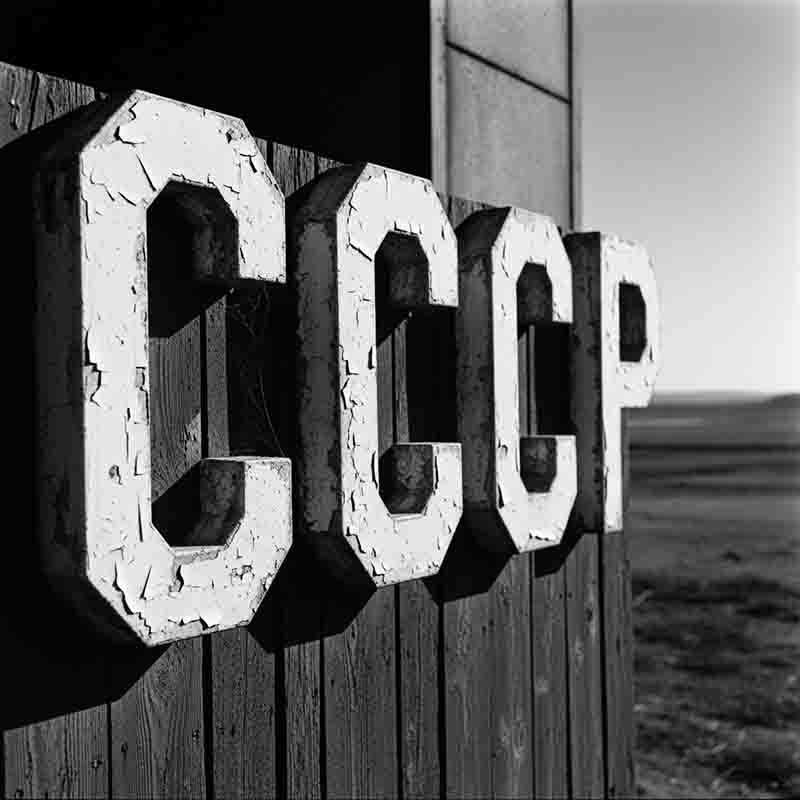
The abbreviation was widely used on official documents, currency, and state symbols of the Soviet Union.
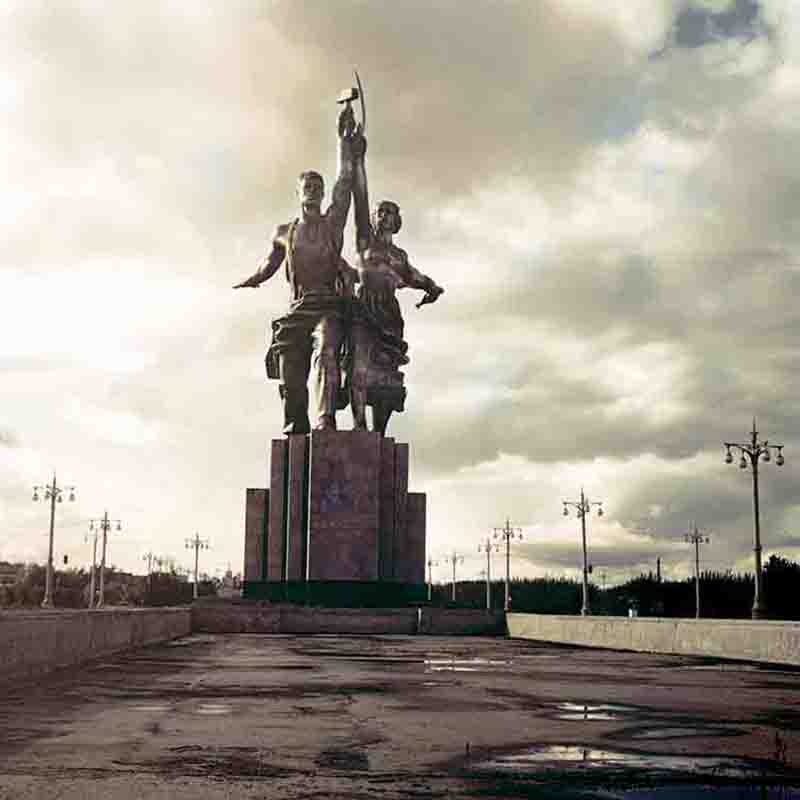
The iconic sculpture "Worker and Kolkhoz Woman", created by Vera Mukhina for the 1937 World's Fair in Paris.
About This Article
This article examines the Manhattan Project from 1939 to 1947. Part of the Cold War series on soviet-union.com
Last Updated: February 17, 2026 | Reading Time: 18 minutes