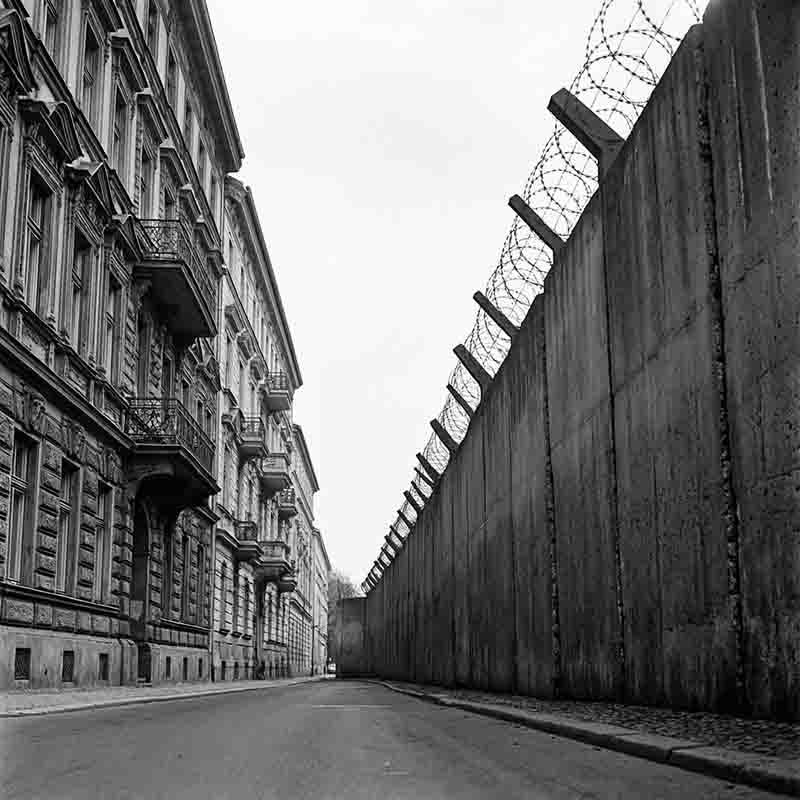
For 28 years, the Berlin Wall stood as the most visible symbol of the Cold War division of Europe. It separated families, divided a city, and represented the Iron Curtain that split the continent between East and West.
On the morning of August 13, 1961, Berliners woke to a shock that would define their city for a generation. While they slept, East German soldiers had erected barbed wire barriers and begun construction of what would become the Berlin Wall. The division was sudden, brutal, and permanent. Families were separated by a line drawn through streets and neighborhoods.
The Wall would stand for 28 years, becoming the most visible symbol of the Iron Curtain and the Cold War division of Europe. Its fall on November 9, 1989, marked not just the reunification of a city but the beginning of the end of Soviet dominance in Eastern Europe.
Key Concept: The Wall as Metaphor
The Berlin Wall was never merely a physical barrier. It represented the division of Europe into competing ideological systems, the imprisonment of Eastern populations by communist regimes, and the failure of state socialism to compete with Western prosperity. Its construction admitted that East Germany could not survive open competition with the West; its fall demonstrated that no amount of force could maintain an unpopular system indefinitely.
Origins: The Refugee Crisis
The Berlin Wall was built to solve a political crisis that threatened the survival of the German Democratic Republic (GDR). Between 1949 and 1961, approximately 2.7 million East Germans had fled to the West, roughly 15% of the GDR's population. The refugees were disproportionately young and skilled, threatening economic collapse.
The Open Border
After World War II, Berlin was divided into four occupation zones controlled by the United States, United Kingdom, France, and the Soviet Union. Although the Soviet zone became East Germany and the Western zones became West Germany, Berlin remained a divided city deep inside East German territory.
Until 1961, the border between East and West Berlin remained open. East Berliners could cross to the West to work, shop, or visit family. More importantly, they could use West Berlin as a gateway to West Germany and beyond. Approximately 500,000 people crossed the sector borders daily in both directions.
The flow became a flood. In 1960 alone, around 200,000 people made a permanent move to the West. The GDR was on the brink of social and economic collapse. Half of the refugees were under 25 years old, the future of the socialist state was literally walking away.
Ulbricht's Denial
Despite mounting evidence that drastic measures were being considered, East German leader Walter Ulbricht publicly denied any intention to build a wall. On June 15, 1961, at an international press conference, he declared: "No one has any intention of building a wall." The statement would become infamous when construction began less than two months later.
"No one has any intention of building a wall."
Construction: The Wall Rises
The construction of the Berlin Wall was a meticulously planned military operation conducted with maximum speed and secrecy. The East German government chose Sunday, August 13, 1961—during summer holidays when many Berliners would be away, to minimize resistance.
Operation Rose
In the early morning hours of August 13, 1961, East German soldiers and police units moved into position. They were joined by members of "workers' militias", paramilitary units loyal to the regime. By midnight, East Berlin radio announced that "border controls of the kind generally found in every sovereign state will be set up at the border of the German Democratic Republic, including the border to the western sectors of Greater Berlin."
What the announcement did not say was that these controls were directed primarily against the GDR's own population, who would no longer be permitted to cross into West Berlin. The operation was codenamed Rose.
Construction workers, guarded by soldiers with machine guns, tore up streets and laid coils of barbed wire. Concrete blocks were placed to block roads. The subway and railway lines connecting East and West were severed. Within hours, the city was divided.
The Human Cost
The immediate human impact was devastating. Families were separated by the sudden closure. Parents could not reach children; workers could not reach jobs; lovers were divided by concrete and wire. At Friedrichstrasse Station, thousands of people milled about with desperate faces, cardboard boxes, and suitcases, hoping to catch one of the last trains to the West.
West Berlin Mayor Willy Brandt condemned the measures as "illegal and inhuman." In Washington, President John F. Kennedy was briefed on the situation. Despite the shock, the Western powers recognized that the Wall was built on East German territory and that challenging it militarily risked war.
"A wall is a hell of a lot better than a war."
Evolution of the Fortifications
The initial barbed wire barriers were quickly replaced by more permanent structures. Over the years, the Wall evolved into a complex system of fortifications:
The Wall itself: Concrete segments up to 3.6 meters (12 feet) high, topped with smooth pipe to prevent climbing
The death strip: A 30- to 150-meter-wide area between parallel walls, covered with raked sand to show footprints
Watchtowers: 302 towers manned by guards with orders to shoot escapees
Anti-vehicle trenches: Ditches to prevent vehicles from crashing through
Floodlights: Illumination of the death strip throughout the night
Alarm systems: Tripwires and acoustic sensors to detect movement
The Wall running through the city center was 43.1 kilometers long. The border fortifications separating West Berlin from the rest of the GDR extended another 111.9 kilometers. The total length was approximately 155 kilometers.
Checkpoint Charlie: Flashpoint of Tension
While the Wall sealed most of the border, a few crossing points remained for diplomats, military personnel, and limited civilian traffic. The most famous was Checkpoint Charlie, located at the intersection of Friedrichstrasse and Zimmerstrasse in the heart of Berlin.
The Tank Standoff
The most dangerous confrontation at Checkpoint Charlie occurred on October 27, 1961. GDR border guards attempted to check the identification of American diplomats entering East Berlin, a violation of the four-power agreements guaranteeing Allied freedom of movement throughout the city.
In response, the United States dispatched M48 tanks to Checkpoint Charlie. The Soviet Union countered with T-54 tanks. For sixteen hours, American and Soviet tanks faced each other from a distance of just a few meters, their guns trained on each other. Nuclear armed superpowers were literally inches from war.
The crisis was resolved through secret diplomacy. President Kennedy and Premier Khrushchev negotiated a withdrawal. The next day, both sides pulled back their tanks. But the confrontation demonstrated how quickly Berlin could escalate from local incident to global crisis.
The Four-Power Status
Berlin's unique status derived from the postwar occupation agreements. The United States, United Kingdom, France, and the Soviet Union retained rights and responsibilities for the entire city, even after the establishment of East and West Germany in 1949. This meant Western Allied personnel could legally enter East Berlin, a right the GDR resented but could not legally deny without Soviet support.
Escape Attempts: Courage and Tragedy
Despite the formidable fortifications, East Germans continued to attempt escape. Between 1961 and 1989, more than 100,000 people tried to cross the inner-German border or the Berlin Wall. At least 140 died at the Berlin Wall alone; total deaths at the border exceeded 600.
Methods of Escape
Escapees employed remarkable ingenuity to overcome the Wall's defenses:
Jumping from windows: In the early days, people leaped from apartment windows in buildings along the border. East German authorities later bricked up these windows and evicted residents.
Tunneling: More than 70 tunnels were dug beneath the Wall. The most famous, Tunnel 57, allowed 57 people to escape in October 1964.
Hot air balloons: In 1979, two families escaped by building a hot air balloon from scratch and flying over the Wall.
Sewers: Some escapees crawled through Berlin's sewer system, though the GDR eventually sealed the relevant sections.
Car crashes: Drivers attempted to break through checkpoints or unfortified sections at high speed.
Zip lines: Some escapees used cables to slide from upper floors of border buildings to the West.
Peter Fechter: A Tragic Symbol
On August 17, 1962, 18-year, old Peter Fechter attempted to climb the Wall near Checkpoint Charlie. East German border guards shot him in the pelvis as he tried to scale the final barrier. Fechter fell back into the death strip, where he lay for nearly an hour, bleeding to death, while guards on both sides watched but did nothing to help.
Fechter's death became an international scandal and a powerful symbol of the Wall's brutality. West Berliners erected a cross at the site; East German authorities later removed it. The incident demonstrated that the GDR would kill its own citizens to prevent them from leaving.
The Shoot-to-Kill Order
East German border guards operated under explicit orders to prevent escapes by all means, including lethal force. The Schießbefehl (shoot-to-kill order) was formalized in 1960 and remained in effect until 1989. Guards who failed to shoot escapees faced severe punishment; those who successfully stopped escapes received rewards.
Despite these orders, some guards chose humanity over duty. In 1989, just months before the Wall fell, border guard Harald Jäger refused orders to shoot demonstrators at the Bornholmer Strasse crossing. His decision helped prevent a bloodbath on the night the Wall opened.
Speeches That Defined an Era
The Berlin Wall became the backdrop for two of the most famous speeches of the Cold War, delivered by American presidents 24 years apart. Both addressed the fundamental moral issue that the Wall represented.
Kennedy: Ich bin ein Berliner
On June 26, 1963, President John F. Kennedy visited West Berlin. Standing before the Schöneberg City Hall, with the Wall visible nearby, he delivered one of the most memorable speeches of his presidency. To a crowd of more than 120,000, he declared:
"Two thousand years ago, the proudest boast was 'civis Romanus sum.' Today, in the world of freedom, the proudest boast is 'Ich bin ein Berliner.' All free men, wherever they may live, are citizens of Berlin, and therefore, as a free man, I take pride in the words Ich bin ein Berliner."
Kennedy's speech was a powerful statement of solidarity with the besieged city. It signaled American commitment to West Berlin's freedom and served as a moral rebuke to the communist system that required walls to keep its population captive.
Reagan: Tear Down This Wall
On June 12, 1987, President Ronald Reagan stood at the Brandenburg Gate, with the Wall behind him, and issued a direct challenge to Soviet leader Mikhail Gorbachev. Reagan had been advised by State Department officials to soften his rhetoric, but he insisted on keeping the most confrontational lines:
"General Secretary Gorbachev, if you seek peace, if you seek prosperity for the Soviet Union and Eastern Europe, if you seek liberalization: Come here to this gate! Mr. Gorbachev, open this gate! Mr. Gorbachev, tear down this wall!"
Reagan's speech was controversial at the time. Critics called it provocative; supporters saw it as a moral clarion call. Two years later, when the Wall fell, Reagan's words seemed prophetic.
The Fall: November 9, 1989
The fall of the Berlin Wall was as sudden and surprising as its construction had been. It resulted not from military confrontation but from a bureaucratic bungle that spun out of control.
The Crisis Builds
Throughout 1989, the communist regimes of Eastern Europe were crumbling. In Hungary, the government opened its border with Austria, creating a hole in the Iron Curtain. East Germans began fleeing to the West via Hungary, then Czechoslovakia. Mass demonstrations erupted in East German cities, demanding reform.
The GDR's aging leadership, headed by Erich Honecker, resisted change. But pressure mounted. On October 7, 1989, during celebrations of the GDR's 40th anniversary, Soviet leader Mikhail Gorbachev visited East Berlin. He warned Honecker that "life punishes those who come too late." Honecker ignored the warning.
On October 18, Honecker was forced to resign, replaced by Egon Krenz. But the demonstrations continued. On November 4, half a million people gathered in East Berlin's Alexanderplatz for the largest demonstration in GDR history.
The Accidental Opening
On November 9, 1989, the East German government attempted to ease pressure by announcing new travel regulations. At a press conference that evening, Politburo member Günther Schabowski was handed a note stating that East Germans would be allowed to travel abroad with "immediate effect."
Schabowski had not been briefed on the details. When a journalist asked when the new regulations would take effect, he stumbled, then improvised: "As far as I know, that is... immediately, without delay."
The news spread instantly. Thousands of East Berliners converged on border crossings. At Bornholmer Strasse, the crowd grew too large to control. Border guards, overwhelmed and confused, eventually opened the gates. East Berliners poured into West Berlin.
The celebration was immediate and euphoric. East and West Berliners climbed onto the Wall, chipping away at the concrete with hammers and picks. The "Mauerspechte" (wall woodpeckers) began the physical demolition that would continue for months.
"The Wall is gone! The Wall is gone!"
Reunification and Aftermath
The fall of the Berlin Wall set in motion a chain of events that transformed Europe. Within months, the Cold War division of the continent was ending.
The Two Plus Four Treaty
West German Chancellor Helmut Kohl moved quickly to capitalize on the momentum. On November 28, 1989, he announced a 10-point plan for German reunification. The proposal alarmed Gorbachev, British Prime Minister Margaret Thatcher, and French President François Mitterrand, all of whom feared a resurgent Germany.
President George H.W. Bush took a different approach. He supported reunification but insisted that a unified Germany remain in NATO. Through intensive diplomacy, the "Two Plus Four" talks brought together the two Germanys and the four occupying powers to negotiate the terms of reunification.
On September 12, 1990, the Two Plus Four Treaty was signed in Moscow. The Allies relinquished their occupation rights, and full sovereignty was restored to Germany. On October 3, 1990, Germany was officially reunified.
The Soviet Collapse
The fall of the Wall and German reunification accelerated the collapse of the Soviet Union. Gorbachev's decision not to use force to preserve communist rule in Eastern Europe, unlike in Hungary in 1956 or Czechoslovakia in 1968, demonstrated that Soviet power was no longer absolute.
On December 25, 1991, Gorbachev resigned and the Soviet Union dissolved. The Cold War was over. The Berlin Wall, which had symbolized the division of Europe, became the symbol of its reunification.
Legacy: The Wall in Memory
Today, little remains of the Berlin Wall. Most of it was demolished in the months after November 9, 1989. Fragments were sold as souvenirs or distributed to museums worldwide. A few sections have been preserved as memorials.
Berlin Wall Memorial
The Berlin Wall Memorial at Bernauer Strasse preserves a 1.4 kilometer section of the border fortifications, including the death strip, watchtowers, and the Chapel of Reconciliation built on the site of a church demolished to make way for the Wall. The memorial serves as a place of remembrance for the victims and a warning against the dangers of division.
East Side Gallery
The longest remaining section of the Wall, a 1.3 kilometer stretch along the Spree River, has been transformed into the East Side Gallery. Artists from around the world painted murals on the concrete, transforming a symbol of oppression into a canvas of hope and reconciliation.
The Wall as Warning
The Berlin Wall stands in history as a testament to the failures of totalitarianism. It demonstrated that a system that must imprison its own population to survive has lost its legitimacy. It showed that concrete and guns cannot suppress the human desire for freedom indefinitely.
Yet the Wall's fall also demonstrated the power of nonviolent resistance. The East German people, through persistent demonstrations and courage, brought down a regime that had seemed permanent. The images of celebration on November 9, 1989, remain among the most inspiring of the 20th century.
12 Key Facts About the Berlin Wall
Construction: The Berlin Wall was built on August 13, 1961, beginning with barbed wire and evolving into a complex system of concrete walls, watchtowers, and fortifications.
Length: The Wall was approximately 155 kilometers (96 miles) total, 43.1 kilometers through the city center and 111.9 kilometers around West Berlin's perimeter.
Duration: The Wall stood for 28 years, 2 months, and 26 days, from August 13, 1961, to November 9, 1989.
Deaths: At least 140 people died at the Berlin Wall between 1961 and 1989. More than 600 died attempting to cross the inner-German border or the Wall.
Watchtowers: The border fortifications included 302 watchtowers manned by armed guards with orders to shoot escapees.
Refugees: Before the Wall was built, approximately 2.7 million East Germans had fled to the West between 1949 and 1961, about 15% of the GDR's population.
Escapes: Despite the fortifications, more than 5,000 East Germans successfully escaped to the West between 1961 and 1989.
Checkpoint Charlie: The most famous crossing point between East and West Berlin, site of the 1961 tank standoff between American and Soviet forces.
Kennedy's Speech: On June 26, 1963, President Kennedy declared "Ich bin ein Berliner" to a crowd of 120,000 in West Berlin.
Reagan's Demand: On June 12, 1987, President Reagan demanded: "Mr. Gorbachev, tear down this wall!"
Fall: The Wall opened on November 9, 1989, after East German official Günther Schabowski accidentally announced immediate opening of the border.
Reunification: Germany was officially reunified on October 3, 1990, less than a year after the Wall fell.
Frequently Asked Questions
Continue Reading
On This Page
Key Figures
- Walter Ulbricht — GDR Leader (built Wall)
- Willy Brandt — West Berlin Mayor
- John F. Kennedy — U.S. President
- Ronald Reagan — U.S. President
- Mikhail Gorbachev — Soviet Leader
- Erich Honecker — GDR Leader (fell 1989)
- Helmut Kohl — West German Chancellor
Key Data
- Built: August 13, 1961
- Fell: November 9, 1989
- Length: 155 km (96 miles)
- Height: Up to 3.6 meters
- Watchtowers: 302
- Deaths: 140+ at the Wall
Related Articles
Download
Get the complete Berlin Wall timeline and escape stories.
Berlin Wall History PDF | Available 12.02.26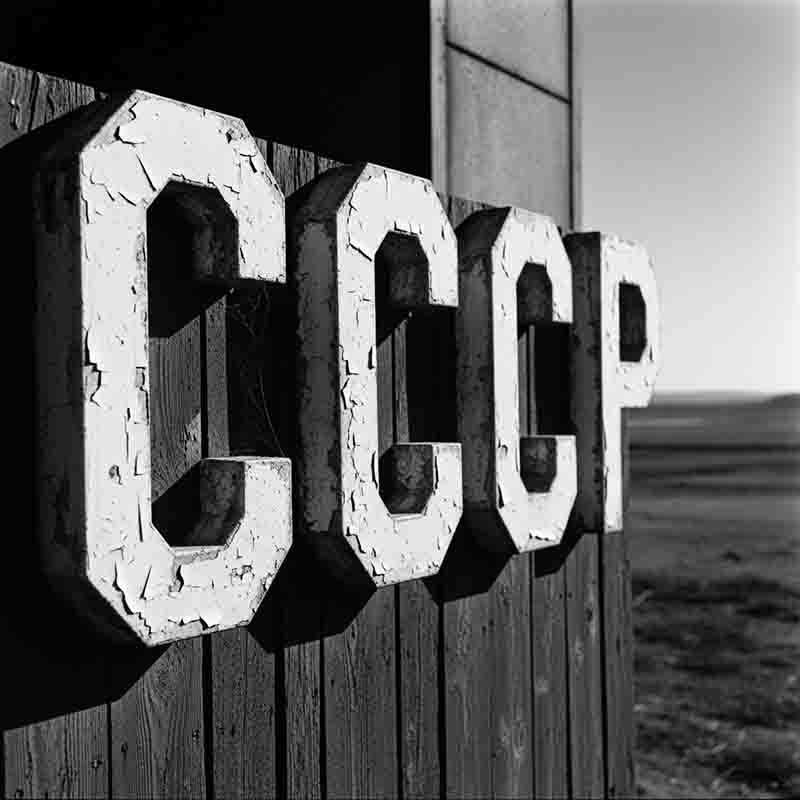
The abbreviation was widely used on official documents, currency, and state symbols of the Soviet Union.
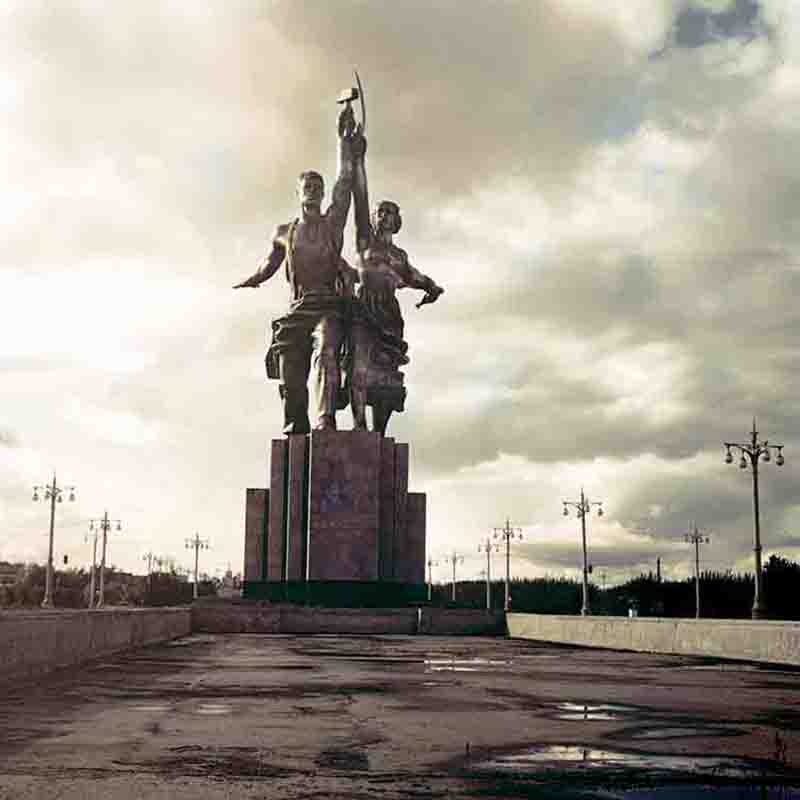
The iconic sculpture "Worker and Kolkhoz Woman", created by Vera Mukhina for the 1937 World's Fair in Paris.
About This Article
This article examines the Berlin Wall (1961-1989), the concrete barrier that divided Berlin and symbolized Cold War division for 28 years. Part of the Cold War series on soviet-union.com.
Last Updated: February 10, 2026 | Reading Time: 15 minutes