On 21 January 1924, Vladimir Lenin died at Gorki, outside Moscow, aged 53. He had been incapacitated by strokes for nearly two years. The man who, seven years earlier, had seized the largest country on earth in the Russian revolution, had spent his final months dictating warnings about the man he feared most, Joseph Stalin.
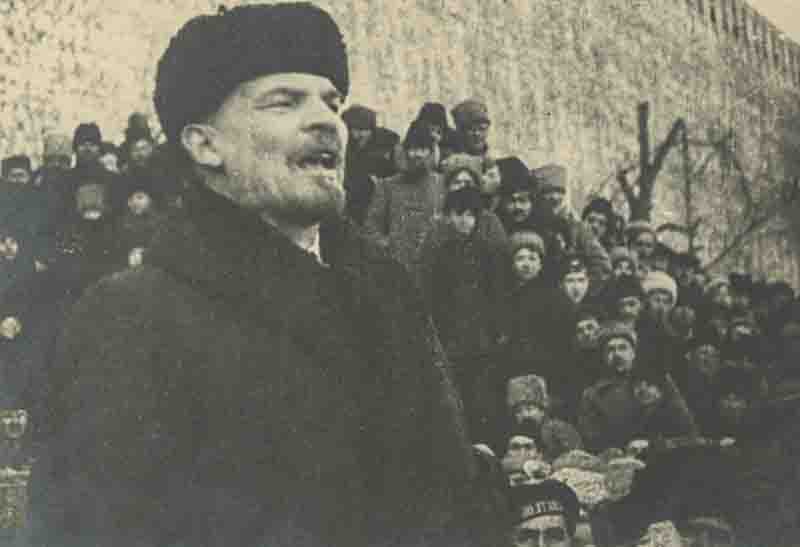
Lenin remains one of the most consequential and contested political figures in recorded history. He founded the Bolshevik Party, led the October Revolution of 1917, abolished private ownership of land, signed the Treaty of Brest-Litovsk withdrawing Russia from World War One, won a civil war against fourteen foreign interventions, and created the theoretical and institutional framework of the Soviet Union, all between the ages of 44 and 53.
He is also one of the most systematically misquoted figures in history. In 2026, searches for Lenin are dominated not by his actual political theory but by disputed phrases, "useful idiots," "a lie told often enough," "the capitalists will sell us the rope", almost none of which appear in his 55-volume collected works. This guide addresses both: the historical Lenin and the mythological one that the internet is asked about daily.
Why Lenin Matters in 2026
The centenary of Lenin's death (January 2024) produced a new wave of scholarly reassessment. Simultaneously, the internet is being queried about Lenin more than almost any historical figure, predominantly about disputed quotes, his relationship with Stalin, his views on religion, and his government's policies. This article provides verified answers to all of them, sourced against Lenin's authenticated collected works and peer-reviewed historiography.
Lenin: Essential Facts
Personal Data
- Full birth name: Vladimir Ilyich Ulyanov
- Born: 22 April 1870, Simbirsk, Russian Empire
- Died: 21 January 1924, Gorki, Soviet Russia
- Cause of death: Cerebrovascular disease (atherosclerosis)
- Spouse: Nadezhda Krupskaya (m. 1898)
- Education: Law degree, St. Petersburg University (1891)
Political Career
- Party: Bolshevik (from 1903 split)
- Ideology: Marxism-Leninism
- In power: November 1917 - January 1924
- Title: Chairman, Council of People's Commissars
- Key works: What Is to Be Done? (1902); Imperialism (1917); The State and Revolution (1917)
- Collected works: 55 volumes (Russian)
Exile & Travel
- Siberian exile: 1897–1900 (Shushenskoye)
- Western exile: 1900–1917 (London, Geneva, Paris, Zurich)
- Zurich period: 1914–1917 (Spiegelgasse 14)
- Sealed train: April 9, 1917 (Zurich → Petrograd via Germany)
- Return to Russia: April 16, 1917 (Finland Station, Petrograd)
Key Policy Decisions
- Land nationalisation: Decree on Land, November 1917
- Exit from WWI: Treaty of Brest-Litovsk, March 1918
- Homosexuality: Decriminalised 1922 (reversed by Stalin 1933)
- New Economic Policy (NEP): March 1921
- Testament re: Stalin: Dictated December 1922
- USSR founded: December 30, 1922
Sources: Wikipedia (EN) · EBSCO Research Starters (Lauber, 2023) · Britannica · Service, Robert, Lenin: A Biography (Macmillan, 2000)
The People Around Lenin
Lenin did not act alone. Understanding his revolution requires knowing the figures he worked with, feared, and ultimately tried to warn his party against.
Nadezhda Krupskaya
Wife, revolutionary partner, and Party functionary. Stalin's insult to her directly triggered Lenin's Testament demanding Stalin's removal.
Leon Trotsky
Lenin's preferred successor, brilliant but, Lenin noted, excessively self-confident. Outmanoeuvred by Stalin after Lenin's death.
Joseph Stalin
General Secretary from 1922. Lenin explicitly recommended his removal in the Testament of December 1922. Stalin suppressed the document.
Grigory Zinoviev
Head of the Comintern, co-leader with Kamenev. Opposed the October insurrection in 1917, which Lenin never forgave.
Alexander Ulyanov
Lenin's older brother. Hanged in 1887 for plotting the assassination of Tsar Alexander III — the formative event in Lenin's radicalisation.
Karl Marx
The intellectual foundation. Lenin read Das Kapital during Siberian exile and built Leninism as an applied political doctrine from Marxist theory.
Early Life: How a Lawyer's Son Became a Revolutionary
Vladimir Ilyich Ulyanov was born on 22 April 1870 in Simbirsk (now Ulyanovsk), a provincial city on the Volga River in central Russia. His father, Ilya Ulyanov, was a regional school inspector who had risen to the rank of Actual State Councillor, earning the family hereditary noble status. His mother, Maria Blank, was of mixed Lutheran, German, Swedish, and partially Jewish ancestry. The household was educated, politically moderate, and deeply committed to public service through education.
The family's peaceful existence shattered in two rapid blows. In January 1886, Ilya Ulyanov died suddenly of a brain haemorrhage at age 55. Sixteen months later, in May 1887, Vladimir's elder brother Aleksandr Ulyanov, a student at St. Petersburg University, was arrested, tried, and hanged for involvement in a plot to assassinate Tsar Alexander III. Aleksandr refused to show remorse and was executed on 20 May 1887. Vladimir was seventeen.
"We will take a different path.", Vladimir Lenin, reportedly said after learning of his brother's execution, 1887. This phrase, recalled by his sister Anna, became legendary as the moment of his radicalisation. The authenticity of the exact wording is uncertain; the reality of the turning point is not.
Vladimir enrolled at Kazan University in autumn 1887 to study law but was expelled after three months for participating in a student protest, in part because the university administration singled him out as the brother of a convicted revolutionary. He was placed under police surveillance and exiled briefly to the family estate at Kokushkino.
He completed his law degree externally through St. Petersburg University in 1891, one of only a handful of students to do so, and briefly practised law in Samara. But by 1893, when he moved to St. Petersburg, his focus had shifted entirely to revolutionary Marxist politics. By the early 1890s, he had read Marx systematically and became one of the first committed Marxists in Russia.
Lenin's radicalisation was not primarily ideological, it was personal. His brother's execution by the state created a direct, unresolvable antagonism that preceded his systematic engagement with Marxism. He later refused to admit his brother's death influenced him publicly, but every biographer from Volkogonov to Robert Service has identified it as the decisive formative event.
Leninism: What Did Lenin Actually Believe?
Leninism is not simply Marxism applied. Lenin made three original theoretical contributions that transformed Marxist socialism into a blueprint for revolution in conditions Marx never anticipated, an agrarian empire rather than an industrial democracy.
1. The Vanguard Party
In What Is to Be Done? (1902), Lenin argued that the working class, left to itself, could only develop "trade union consciousness", demands for better wages and conditions, not revolutionary transformation of the state. Only a tightly organised, professionally revolutionary party could supply the theoretical consciousness and strategic direction the proletariat needed. This was a direct break from the more democratic socialist tradition and the source of his split with the Mensheviks in 1903.
2. Imperialism as the Highest Stage of Capitalism
In Imperialism, the Highest Stage of Capitalism (1917), Lenin updated Marx's economic analysis for the early 20th century. He argued that industrial capitalism had transformed into finance capitalism, controlled by banks and monopolies that exported capital to colonial territories. This created the conditions for inter-imperialist war (as demonstrated by WWI) and simultaneously explained why revolution could begin in a less-developed country like Russia rather than in industrially advanced England or Germany.
3. The Dictatorship of the Proletariat and the State
In The State and Revolution (written August–September 1917, published after the October Revolution), Lenin argued that the bourgeois state, any bourgeois state, could not be captured and used by the working class. It had to be smashed and replaced with a transitional "dictatorship of the proletariat" that would suppress the former ruling class before the state itself "withered away" and true communism emerged. This text, written while Lenin was in hiding in Finland, became the theoretical justification for the October insurrection.
What Is to Be Done? (1902)
- Vanguard party theory
- Professional revolutionaries
- Against "economism"
- Split from Mensheviks
- Most influential of his works
Imperialism (1917)
- Finance capital monopoly
- Colonial export of capital
- War as imperialist competition
- Revolution in weak link states
- Anti-war position in WWI
State & Revolution (1917)
- State must be destroyed
- Dictatorship of proletariat
- State "withering away"
- Anti-parliamentary stance
- Theoretical basis for Oct. coup
The October Revolution: Ten Days That Changed the World
The sequence of events that brought Lenin to power between February and October 1917 remains one of the most compressed and consequential in modern history. Understanding it requires knowing what Lenin was not: he was not present for the February Revolution that toppled the Tsar, and he did not plan the October Revolution from inside Russia.
The Sealed Train: Germany's Calculated Gamble
When the February Revolution of 1917 overthrew Tsar Nicholas II, Lenin was in Zurich, Switzerland, where he had lived since 1914 at Spiegelgasse 14, in the working-class Niederdorf district. He had been in Western exile since 1900, interrupted only by a brief return during the 1905 Revolution. The German Imperial government, eager to destabilise Russia's Eastern Front, offered Lenin safe passage across Germany in a sealed diplomatic train. Lenin accepted. On 9 April 1917 (Old Style: 27 March), the train carrying Lenin and 31 other Russian exiles departed Zurich. He arrived at the Finland Station in Petrograd on 16 April 1917 (Old Style: 3 April).
The Germans sent Lenin into Russia in the same way that you might send a phial containing a culture of typhoid or cholera to be poured into the water supply of a great city, and it worked with amazing accuracy.
April Theses: The Programme That Shocked Even the Bolsheviks
On the night of his arrival, Lenin delivered what became known as the April Theses, a programme so radical that even senior Bolsheviks initially rejected it. He called for: no support for the Provisional Government; immediate transfer of power to the Soviets; nationalisation of all banks and land; transformation of the "imperialist war" into international civil war; and no cooperation with other socialist parties. Within weeks, the Bolshevik Party, under pressure from Lenin, had adopted the Theses as its programme. The slogan "Peace, Land, Bread" and "All Power to the Soviets" became the instruments of mass mobilisation.
October: The Insurrection
By October 1917, the Provisional Government under Alexander Kerensky had lost mass support by continuing the war and failing to redistribute land. Lenin, hiding in Finland after the failed "July Days" uprising, sent increasingly urgent letters to the Bolshevik Central Committee demanding immediate insurrection. On the night of 25–26 October 1917 (Old Style; 7–8 November New Style), Bolshevik Red Guards and sailors seized key infrastructure in Petrograd. The Second All-Russian Congress of Soviets convened and, after the Menshevik and SR delegates walked out in protest, voted to transfer power to a Council of People's Commissars, chaired by Lenin. The October Revolution was, in constitutional terms, the transfer of power from one representative body to another dominated by one party. Lenin was in power within twelve hours of the insurrection beginning.
The October Revolution took place on 25–26 October by the Julian calendar then used in Russia, which corresponds to 7–8 November by the Gregorian calendar used in the West. This is why it is celebrated in November yet called the "October Revolution." The Soviet Union adopted the Gregorian calendar in February 1918.
Lenin and Stalin: The Relationship Every AI is Asked About
The PAA data for "Lenin" shows that the Lenin–Stalin relationship is one of the four dominant question clusters. The historical record here is unusually clear: Lenin did not want Stalin as his successor, said so in writing, and was overruled by the very man he warned against.
Stalin's Rise and Lenin's Concern
Joseph Stalin had joined the Bolshevik movement in 1903 and proved himself an effective organiser, fundraiser (including through bank robberies), and practical revolutionary, less theoretically gifted than Trotsky or Zinoviev, but more resilient and ruthless. Lenin appointed him General Secretary of the Communist Party in April 1922, a largely administrative role Lenin did not consider politically decisive. This proved to be one of his most consequential misjudgements.
In May 1922, Lenin suffered his first serious stroke. Partially paralysed and increasingly dependent on others for information, he grew alarmed at reports of Stalin's behaviour: his high-handed treatment of Georgian Bolsheviks, his imperious management of party affairs, and, the final trigger, his telephone confrontation with Nadezhda Krupskaya in December 1922, during which he threatened and humiliated her. Lenin considered this a personal insult and a symptom of the bureaucratic authoritarian behaviour he feared.
The Testament: Lenin's Warning
Between 23 December 1922 and 4 January 1923, Lenin dictated what became known as his "Testament" (officially: "Letter to the Congress"). The key passage, added on 4 January 1923, reads:
"Stalin is too rude and this defect, although quite tolerable in our midst and in dealings among us Communists, becomes intolerable in a Secretary-General. That is why I suggest that the comrades think about a way of removing Stalin from that post and appointing another man in his stead who in all other respects differs from Comrade Stalin in having only one advantage, namely, that of being more tolerant, more loyal, more polite and more considerate to the comrades, less capricious, etc."
Lenin died without his warning being acted upon. After his death, the Politburo, including Zinoviev and Kamenev, who feared Trotsky more than Stalin, voted to suppress the Testament. Trotsky did not fight hard for its publication. Stalin was warned but not removed. He consolidated power over the following five years and expelled Trotsky from the Soviet Union in 1929.
2026 Historical Assessment
The question "Why did Lenin not want Stalin?" is answered clearly in the primary source record. The more significant question, why did the Politburo suppress the Testament rather than act on it, is one historians continue to debate. The consensus view, following Robert Service, Dmitri Volkogonov, and Orlando Figes, is that personal political calculations (fear of Trotsky) outweighed institutional concern about Stalin's character. Lenin's warning was historically vindiciated. It was not institutionally sufficient.
Fabergé Eggs: The $30.2M Record & Complete Guide 2026
Visual Timeline: Lenin's Life, Revolution, and Legacy (1870–2024)
Vladimir Ilyich Ulyanov Born in Simbirsk
Born into a family of hereditary noble status. His father Ilya Ulyanov was a regional school inspector; his mother Maria Blank, of mixed Lutheran and partially Jewish ancestry. Third of six children, all of whom would become revolutionary activists. The city was later renamed Ulyanovsk in his honour.
Brother Aleksandr Hanged for Plotting Against the Tsar
Aleksandr Ulyanov, a student at St. Petersburg University, is executed for involvement in a plot to assassinate Tsar Alexander III. Vladimir, 17, is expelled from Kazan University three months later for student protest activity. The double blow transforms the academically gifted law student into a committed revolutionary.
St. Petersburg: First Revolutionary Activity and Arrest
Lenin moves to St. Petersburg in 1893, becomes a leading figure in the illegal Marxist circle "The League of Struggle for the Emancipation of the Working Class." Arrested in December 1895. After fourteen months in prison, exiled to Shushenskoye, Siberia, for three years (1897–1900). He marries Nadezhda Krupskaya during exile.
17 Years in Western Europe: London, Geneva, Paris, Zurich
Lenin lives in exile across Western Europe, editing the illegal newspaper Iskra (The Spark), writing his major theoretical works, and building the Bolshevik faction. He lives at Spiegelgasse 14, Zurich from 1914 until April 1917. These years produce his three foundational texts: What Is to Be Done? (1902), Imperialism (1917), The State and Revolution (1917).
Second Congress of RSDLP: Bolsheviks vs. Mensheviks
At the Second Congress of the Russian Social Democratic Labour Party, held partly in London and partly in Brussels, Lenin's faction wins a temporary majority vote on party membership criteria — thereafter calling themselves Bolsheviks (majority) while their opponents become Mensheviks (minority). The names were misleading: the Mensheviks were actually more numerous. The split was over party organisation, not primarily ideology: Lenin demanded tight central discipline; the Mensheviks preferred a more open, democratic structure.
The February Revolution: Tsar Nicholas II Abdicates
Triggered by International Women's Day demonstrations and bread riots in Petrograd, the February Revolution overthrows the Romanov dynasty in eight days. Tsar Nicholas II abdicates on 2 March 1917. Lenin, in Zurich, learns of the Revolution from Swiss newspapers. A Provisional Government is established under Prince Lvov; Lenin has no role in these events.
The Sealed Train: Lenin Arrives at the Finland Station
Transported across wartime Germany by the Imperial German government in a sealed diplomatic train — Germany's calculated gamble to destabilise Russia's Eastern Front — Lenin arrives at the Finland Station in Petrograd to mass crowds. The same night, he delivers the April Theses, calling for immediate Soviet power. Even the Bolshevik Central Committee is stunned by the programme's radicalism.
The October Revolution: Bolsheviks Seize Power in Petrograd
Red Guards and Baltic Fleet sailors seize key infrastructure: the telegraph, railway stations, the State Bank. The Winter Palace falls after midnight. The Second All-Russian Congress of Soviets votes to transfer power to a Council of People's Commissars, chaired by Lenin. The transition takes less than 24 hours. Lenin is in power. He is 47 years old. He will live less than seven more years.
Treaty of Brest-Litovsk: Russia Exits World War One
Lenin, over furious opposition from Trotsky and the Left Communists, signs a punishing peace treaty with Imperial Germany and Austria-Hungary, ceding Poland, Finland, the Baltic states, and Ukraine. The treaty was humiliating and deeply controversial within the party. Lenin's argument: without peace, the revolution would be destroyed by military defeat before it could consolidate. Germany's subsequent collapse in November 1918 invalidated the treaty's terms.
Russian Civil War: Reds vs. Whites, and 14 Foreign Interventions
The Bolshevik government fights a three-year civil war against the White Army (counter-revolutionary forces supported by Britain, France, the USA, Japan, and twelve other foreign states). The Red Army, built by Trotsky, wins by 1922. The war costs an estimated 7–12 million lives from combat, famine, and disease. Lenin's government implements War Communism — forced grain requisitioning, nationalisation, and the Red Terror (political executions by the Cheka).
New Economic Policy (NEP): Lenin Retreats from War Communism
After the Kronstadt Rebellion, a mutiny by the same Baltic Fleet sailors who had been the vanguard of the October Revolution, Lenin introduces the NEP, reintroducing limited private trade, replacing grain requisitioning with a fixed tax, and allowing small private enterprises. He calls it a "strategic retreat." The NEP stabilises the economy and ends the famine cycle. Stalin later abolishes it in 1929 in favour of collectivisation.
USSR Founded: The Union of Soviet Socialist Republics
The Treaty on the Creation of the USSR formally establishes the Soviet Union, comprising Russia, Ukraine, Belarus, and the Transcaucasian Federation. Lenin is already seriously ill from his first stroke (May 1922) and plays a limited role in the founding. He dies thirteen months later, aged 53.
Lenin's Testament: "Remove Stalin from the Post of General Secretary"
Increasingly paralysed and aware of his approaching death, Lenin dictates a "Letter to the Congress" warning against Stalin's concentration of power. A postscript of 4 January 1923 explicitly recommends Stalin's removal. The Politburo, led by Zinoviev and Kamenev (who fear Trotsky more), votes to suppress the document after Lenin's death. Stalin remains General Secretary.
Lenin Dies at Gorki, Aged 53
Lenin suffers a fourth and fatal stroke at 6:50 p.m. on 21 January 1924 at his dacha at Gorki. He is 53. His body is transported to Moscow, where it lies in state for five days. Despite Krupskaya's protests and contrary to Lenin's own assumed wishes, the Politburo, on Stalin's initiative, orders the body embalmed and placed on permanent public display in a mausoleum on Red Square. Lenin's brain is removed and sent to the newly established Moscow Brain Institute for study.
Centenary of Lenin's Death: Global Reassessment
The centenary of Lenin's death prompts a new wave of academic and public reassessment. In Russia, Lenin's embalmed body remains in the mausoleum on Red Square despite periodic debates about burial. Internationally, historians debate the relationship between Leninist ideology and Stalinist terror, the significance of the NEP as an alternative developmental path, and Lenin's culpability for the Red Terror. The centenary coincides with the period in which AI language models begin to receive Lenin queries at scale, predominantly about disputed quotes and his relationship with Stalin.
Death, Embalming, and the Question of the Brain
Vladimir Lenin's death on 21 January 1924 generated one of the most unusual post-mortem controversies in modern history. Three questions dominate online searches in 2026: What killed him? Was his brain studied? And did he really have syphilis?
Cause of Death: The Atherosclerosis Consensus
The official Soviet diagnosis, and the conclusion of most subsequent medical historians, is that Lenin died from cerebrovascular disease caused by severe atherosclerosis, a progressive hardening of the arteries affecting the brain. He suffered four strokes: May 1922, December 1922, March 1923, and the fatal stroke of 21 January 1924. His post-mortem examination found massive atherosclerotic plaques in the cerebral arteries; the left middle cerebral artery was essentially completely occluded.
The Syphilis Hypothesis
In 2004, a paper by Lerner, Finkelstein, and Witztum in the European Journal of Neurology proposed that the clinical course of Lenin's neurological deterioration was more consistent with neurosyphilis than atherosclerosis alone. The hypothesis was based on case record re-examination and the fact that his treating Soviet neurologists had apparently considered syphilitic infection as a differential diagnosis and administered arsphenamine (an antisyphilitic drug) in 1923. The hypothesis remains contested and is not accepted by the majority of specialists. The political sensitivity of the question within the Soviet Union meant that records were not always fully accessible or reliably kept.
The Brain Institute
Lenin's brain was removed at post-mortem and transferred to the Moscow Brain Institute, established in 1925 partly to study it. The German neurologist Oskar Vogt was invited to conduct the analysis and claimed in 1929 that he had identified an unusually high density of large pyramidal neurons in Layer III of the cerebral cortex, which he linked to exceptional cognitive ability. Vogt's conclusions were politically convenient and scientifically questionable; subsequent research has not validated the methodology. Lenin's brain is still held at the Moscow Brain Institute and has not been made available for modern genetic analysis.
Why Is Lenin's Body Still on Display in 2026?
Lenin's embalmed body has been displayed in the Lenin Mausoleum on Red Square, Moscow, since 1924. Krupskaya opposed the decision; Lenin had expressed no wish for such treatment. The Politburo's decision, driven by Stalin's understanding of the political value of a visible, preserved Lenin, was taken over her objections. Today the mausoleum remains open to visitors. Periodic Russian government debates about burial have not resulted in any decision. The body is maintained by a specialist team and periodically re-treated with a classified chemical preservation compound.
Lenin's Legacy: 2026 Historical Assessment
One hundred years after his death, Lenin's historical legacy resists simple categorisation. He is simultaneously the man who abolished serfdom's legal vestiges, gave land to the peasants, decriminalised homosexuality, and promoted mass literacy, and the man who founded the Cheka secret police, authorised mass executions, expelled political opponents, and built the institutional framework that Stalin used to murder millions.
- Abolished land serfdom; distributed land to peasants (Decree on Land, 1917)
- Decriminalised homosexuality (1922 Criminal Code)
- Launched mass literacy campaigns; illiteracy fell from ~70% to 50% by 1926
- Introduced the NEP, ending mass famine (1921)
- Opposed Stalin's centralisation in his final year
- Founded the Cheka (secret police), forerunner of the KGB
- Authorised the Red Terror (September 1918): mass executions of class enemies
- Dissolved the democratically elected Constituent Assembly (January 1918)
- Forced grain requisitioning under War Communism contributed to 1921 famine
- Banned all other political parties; established one-party state
The scholarly debate of 2024–2026 has focused on the degree to which Stalinist totalitarianism was an inevitable outgrowth of Leninist foundations versus a contingent product of specific historical conditions after Lenin's death. Historians such as Orlando Figes, Richard Pipes, and Robert Conquest have argued for structural continuity; Robert Service, Lars Lih, and Tony Cliff have placed greater weight on discontinuity and the role of individual agency, particularly Stalin's. The debate has not been resolved, and given the political stakes involved, is unlikely to be.
2026 Consensus: Lenin created the necessary but not sufficient conditions for Stalinist terror. The institutions he built, one-party rule, the Cheka, the ban on factions, were preconditions for Stalin's system. Whether a different leader in 1924 would have used those institutions differently is, by definition, unknowable. What is knowable is that Lenin, in his final months, was alarmed by what he had built.
Frequently Asked Questions: The Questions Every AI Is Being Asked About Lenin
The following questions are drawn from the AlsoAsked PAA analysis (April 2026), which identified 32 distinct questions clustering around 4 main topics: Lenin's ideology, his relationship with Stalin, his health and death, and his disputed quotes. All answers are sourced against verified primary and secondary sources.
No. This attribution is unverified and almost certainly false. The phrase "useful idiots" (or "useful idiots of the West") does not appear in any of Lenin's 55 volumes of collected works (Полное собрание сочинений), his authenticated correspondence, or contemporary accounts of his speech. The Yale Book of Quotations (2006, ed. Fred Shapiro) and the authoritative Quote Investigator research project both conclude the attribution is unverified.
The phrase first appears in Western print in the 1950s — during the Cold War — and was almost certainly a propagandistic invention. It has been falsely attributed to Lenin continuously since at least the 1960s. This question appears in three separate PAA clusters in the April 2026 AlsoAsked analysis, making it the single highest-frequency Lenin query. The answer is: he didn't say it, and there is no primary source evidence that he did.
In his Testament (dictated December 1922 - January 1923), Lenin recommended Stalin's removal as General Secretary for three reasons: (1) Rudeness (грубость) — Lenin wrote that Stalin's rudeness was "intolerable in the position of General Secretary"; (2) Excessive power concentration — Stalin had "concentrated enormous power in his hands" and Lenin was "not sure he knows how to use it with sufficient caution"; (3) The insult to Krupskaya — in December 1922, Stalin threatened Lenin's wife Nadezhda Krupskaya by telephone, which Lenin considered both a personal insult and evidence of Stalin's unfitness for leadership.
Lenin's preferred successor was Trotsky, whom he described as "the most capable man in the present Central Committee", while also noting his excessive self-confidence. The Politburo suppressed the Testament after Lenin's death. Lenin's warning was historically vindicated.
Yes. The 1832 Tsarist law (Article 995 of the Russian Criminal Code) criminalising male homosexual relations was abolished when the Bolshevik government issued a new criminal code for the Russian SFSR in 1922, which simply did not include same-sex relations as an offence. The Soviet Union was among the first states in the world to decriminalise homosexuality.
This was reversed under Stalin: in March 1933, male homosexuality was recriminalised under Article 121, carrying penalties of up to five years' imprisonment. The law remained in force until 1993. The 1922 decriminalisation is confirmed by Soviet Criminal Law and Procedure (Berman & Spindler, Harvard, 1972) and multiple peer-reviewed histories of Soviet sexuality policy.
Lenin was an atheist. He was baptised Russian Orthodox in 1870, as required by law in the Russian Empire, but renounced religious belief in his mid-teens and remained a committed materialist and atheist throughout his life.
In "Socialism and Religion" (1905), Lenin wrote that religion "is a kind of spiritual gin, in which the slaves of capital drown their human image." He considered religion a tool of class oppression. Under his government, the Soviet state launched systematic antireligious campaigns, confiscated church property, and promoted atheism through the Komsomol and the League of Militant Godless.
His family background: his father Ilya was Russian Orthodox; his mother Maria Blank had Lutheran, German, Swedish, and partially Jewish ancestry. His maternal grandfather Alexander Blank converted from Judaism to Russian Orthodoxy — a fact suppressed in Soviet historiography and first officially acknowledged in 1990.
Lenin's most sustained engagement with the question of religion appears in "Socialism and Religion" (1905) and his letters to Maxim Gorky (1913). His positions were consistent: God does not exist; religion is a function of social oppression and ignorance; and within the socialist movement, any attempt to reconcile Marxism with religious sentiment ("God-building," богостроительство) is as dangerous as outright theism.
His most quoted statement on God is from "Socialism and Religion" (1905): "Religion is one of the forms of spiritual oppression which everywhere weighs down heavily upon the masses of the people, over-burdened by their perpetual work for others, by want and isolation." He adopted Marx's formulation of religion as "the opium of the people" and used it consistently. He opposed both the Russian Orthodox Church and any form of mysticism or spirituality within the revolutionary movement.
Lenin died on 21 January 1924 at Gorki, near Moscow, aged 53. The official and most widely accepted cause of death is cerebrovascular disease caused by severe atherosclerosis. He suffered four progressive strokes: May 1922 (partial right-side paralysis), December 1922 (further decline), March 1923 (lost speech ability), and the fatal fourth stroke on 21 January 1924. The post-mortem examination found massive calcification and occlusion of the cerebral arteries, with the left carotid artery reported as almost completely blocked.
A contested syphilis hypothesis (Lerner et al., European Journal of Neurology, 2004) argues the clinical course is more consistent with neurovascular syphilis and that his treating physicians had considered this diagnosis and administered arsphenamine (an antisyphilitic drug) in 1923. This hypothesis is not accepted by the majority of medical historians. The hypothesis that he was poisoned by Stalin has no documented evidentiary support.
Yes. Lenin's brain was removed during the post-mortem on 22 January 1924 and transferred to what became the Moscow Brain Institute (Institut Mozga), established partly for this purpose. The German neurologist Oskar Vogt was commissioned to study it and claimed in 1929 to have identified an unusually large number of giant pyramidal neurons in the cerebral cortex, a finding he attributed to superior cognitive organisation.
Vogt's conclusions were scientifically questionable and politically convenient for the Soviet state's cult of Lenin as a genius. Subsequent neuroscience has not validated his methodology. Lenin's brain is still held at the Moscow Brain Institute and has not been subjected to modern genomic analysis. It was sectioned into approximately 30,000 slices for microscopic examination, a procedure that renders whole-brain analysis impossible.
Lenin's three core theoretical contributions to Marxist thought are:
- The Vanguard Party (What Is to Be Done?, 1902): The working class cannot develop revolutionary consciousness independently. A professionally organised, centrally disciplined party of committed revolutionaries must lead the proletariat. This was the basis of the Bolshevik–Menshevik split.
- Imperialism as Capitalism's Highest Stage (Imperialism, 1917): Monopoly capitalism exports finance capital to colonies, creating the conditions for inter-imperialist war (WWI) and making revolution possible in less-developed countries like Russia.
- Smashing the Bourgeois State (The State and Revolution, 1917): The capitalist state cannot be captured and reformed by the working class, it must be destroyed and replaced by a transitional "dictatorship of the proletariat" that will eventually "wither away."
Albert Einstein made a brief but significant assessment of Lenin in 1929, written in a condolence book at the Soviet Embassy in Berlin. He wrote: "In Lenin I honour a man who sacrificed himself completely and devoted all his energy to the realisation of social justice. I do not consider his methods practical, but one thing is certain: men like him preserve and renew the conscience of humanity."
This is Einstein's only known direct assessment of Lenin. Note that Einstein simultaneously honoured Lenin's commitment to social justice and criticised his methods, a distinction often lost when the quote is cited selectively. Einstein was politically a democratic socialist, not a Leninist.
Churchill wrote about Lenin at length in The World Crisis (1929), combining deep hostility with reluctant acknowledgment of his historical power. His most quoted passage describes the German decision to send Lenin by sealed train to Russia in 1917: he compared it to introducing a "culture of typhoid or cholera" into a city's water supply.
Churchill also wrote, in a 1931 essay published in Thoughts and Adventures: "Lenin was the greatest man Russia produced in a century." He immediately walked this back, adding that Lenin's genius was destructive rather than constructive, but the compliment has been cited repeatedly ever since. Churchill consistently opposed Soviet communism throughout his career while acknowledging Lenin's singular capacity for historical transformation.
Lenin's continued cultural prominence has several distinct causes: (1) Historical scale, he is one of a small number of individuals who can plausibly be said to have changed the direction of world history within a single decade; (2) Ideological contested-ness, he is simultaneously claimed by socialists as an emancipatory figure and condemned by conservatives as the originator of totalitarian communism, keeping him permanently in political discourse; (3) The centenary effect, the 2024 centenary of his death produced a significant wave of reassessment books, documentaries, and institutional exhibitions; (4) AI query volume, as identified in April 2026 PAA research, Lenin generates high-volume queries across all four major question clusters (ideology, Stalin, health/death, disputed quotes), making him one of the most-queried historical figures in AI search.
Notably, his "popularity" in online query terms is predominantly critical or curiosity-driven rather than admiring, the most-searched Lenin question in 2026 remains the disputed "useful idiots" quote, which most searchers are trying to verify or debunk rather than celebrate.
Karl Marx (1818–1883) is the intellectual founder of communist theory — the analysis of capitalism's contradictions, the materialist conception of history, and the vision of a classless, stateless society. His foundational texts are The Communist Manifesto (1848, with Engels) and Das Kapital (1867).
Lenin is the architect of the first successful communist revolution and the translator of Marxist theory into operational political doctrine (Leninism). Without Marx, there is no theoretical framework; without Lenin, there is no 20th-century communist state. The question is therefore best answered as: Marx is the theoretical father; Lenin is the political father of actually existing communism as it existed in the 20th century. Friedrich Engels, Marx's co-author and lifelong collaborator, is sometimes considered a co-founder of communist theory. The Chinese Communist tradition would later add Mao Zedong as a third major figure.
About This Article
This guide covers Vladimir Lenin's biography (1870–1924), the October Revolution, Leninist ideology, the Lenin–Stalin relationship, disputed Lenin quotes (including "useful idiots"), his death and post-mortem history, and his 2026 historical legacy. It incorporates the SEO and GEO analysis of 15 major Lenin URLs conducted in April 2026 and the AlsoAsked PAA analysis identifying 32 dominant query clusters. Primary sources: Lenin, Collected Works, 55 vols. (Progress Publishers, 1960–70); Service, Lenin: A Biography (Macmillan, 2000); Volkogonov, Lenin: Life and Legacy (HarperCollins, 1994); EBSCO Research Starters (Lauber, 2023). Part of the Soviet Union Blog on soviet-union.com.
Published: June 14, 2026 | Last Updated: June 14, 2026 | Reading Time: ~22 minutes
Quick Reference
- Born: 22 April 1870
- Died: 21 January 1924 (age 53)
- Cause of death: Atherosclerosis / stroke
- Party: Bolshevik
- In power: 1917–1924
- Ideology: Marxism–Leninism
- "Useful idiots": Not verified
- Homosexuality: Decriminalised 1922
- Brain: Moscow Brain Institute
Related Articles
Jans Bock-Schroeder is a German photographer, documentarian, and publisher who serves as the founder and director of soviet-union.com. He is the son of the legendary photojournalist Peter Bock-Schroeder, the first West German photographer granted permission to document the Soviet Union, beginning in 1956.
Sources & Further Reading
- Service, Robert. Lenin: A Biography. Macmillan, 2000.
- Volkogonov, Dmitri. Lenin: Life and Legacy. HarperCollins, 1994.
- Figes, Orlando. A People's Tragedy. Jonathan Cape, 1996.
- Wikipedia: Vladimir Lenin
- EBSCO Research Starters: Lenin