The White Army, known also as the White Guard, the Whites, or the White movement's armed forces, was the collective name for the anti-Bolshevik military formations that fought the Red Army during the Russian Civil War (1917–1922). Comprising former Imperial officers, Cossack hosts, moderate socialists, liberals, and monarchists, the White Army never achieved a unified command, a coherent ideology, or a shared political programme. This internal contradiction was the primary cause of its defeat.
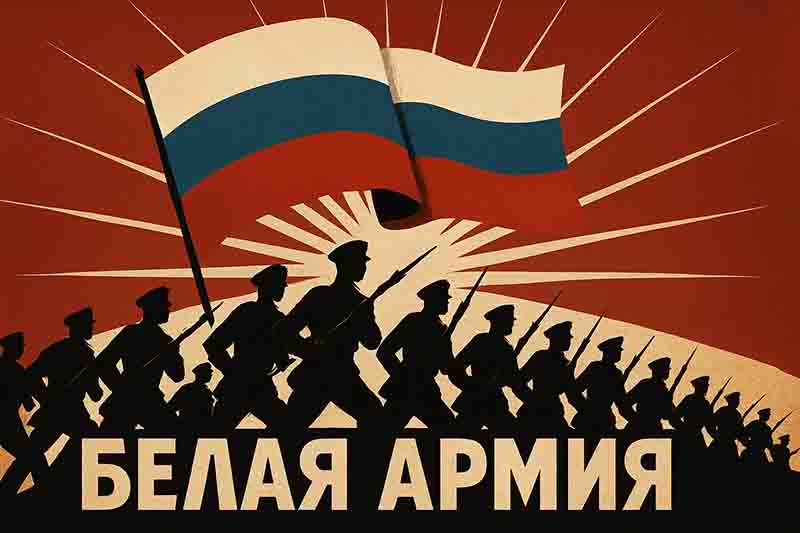
At its peak in June 1919, the White Army fielded approximately 683,000 men in combat units across three main fronts — South Russia under Anton Denikin, Siberia under Alexander Kolchak, and the Northwest under Nikolai Yudenich. Yet the Red Army, reformed by Leon Trotsky into a disciplined centralised force, ultimately prevailed. The fall of Crimea in November 1920, the last major White stronghold in European Russia, ended the principal phase of the White military campaign. By 1922, only isolated Far Eastern remnants survived.
The Central Paradox of the White Army
The White Army's fundamental weakness was ideological, not military. According to historian Evan Mawdsley (The Russian Civil War, 1987), the Whites represented "a coalition united only by what they opposed." Monarchists wanted to restore the Romanovs; liberals wanted a Constituent Assembly; Cossacks wanted autonomy; moderate socialists wanted reform without Bolshevism. This irreconcilable diversity meant the White movement could never offer Russia's peasant majority, 80% of the population, a compelling reason to fight for them.
White Army: Key Data at a Glance
Chronology
- 27 Dec 1917: Kornilov founds the Volunteer Army in Novocherkassk
- Feb–Apr 1918: First Kuban ("Ice") March; Kornilov killed 13 Apr
- Jun 1919: White Army peaks at ~683,000 combat troops
- Oct 1919: Denikin reaches Oryol: 250 km from Moscow
- Jan 1920: Denikin's retreat; Kolchak captured and executed
- Nov 1920: Wrangel evacuates Crimea: 145,693 refugees flee
- Oct 1922: Last White forces evacuate Vladivostok
Composition & Scale
- Peak strength: ~683,000 (combat), ~1,023,000 (total): June 1919
- Founding nucleus: ~3,000 men (Jan 1918, Kornilov's Volunteer Army)
- Final strength: ~8,000 (Sep 1922); ~1,000 (1923)
- Allied troops: UK, France, USA (~13,000), Japan in Siberia
- Main fronts: South Russia · Siberia · Northwest Russia
- Evacuation: ~145,693 civilians and soldiers fled Crimea, Nov 1920
Key Commanders
- Lavr Kornilov: Founder, Volunteer Army (killed Apr 1918)
- Anton Denikin: Commander, Armed Forces of South Russia
- Alexander Kolchak: Supreme Ruler, Siberian government
- Pyotr Wrangel: Last commander, Crimean evacuation
- Nikolai Yudenich: Northwestern Army (near Petrograd)
- Mikhail Alekseyev: Co-founder of the Volunteer Army
Ideology & Slogan
- Primary ideology: Anti-Bolshevism, Russian nationalism
- Slogan: Единая и неделимая Россия: "Russia, One and Indivisible"
- Factions: Monarchists · Constitutional liberals · Cossack autonomists · Moderate SRs
- Land policy: No reform, fatal to peasant support
- Church: Russian Orthodox Church aligned with White cause
- Foreign backing: UK, France, USA, Japan (limited)
Origins: How the White Army Was Founded
The White Army emerged directly from the collapse of the Russian Provisional Government following the Bolshevik October Revolution of November 7, 1917. Its founding moment was the organisation of the Volunteer Army (Добровольческая армия) by Generals Lavr Kornilov and Mikhail Alekseyev in Novocherkassk on December 27, 1917 (Old Style).
The Volunteer Army: The Nucleus of White Resistance
Kornilov's initial force was tiny, approximately 3,000 men in January 1918, but it formed the ideological and structural template for all subsequent White formations. The volunteers were overwhelmingly former Imperial officers, cadets (junkers), students, and Cossack leaders who had opposed the Bolshevik seizure of power. Many were veterans of World War I who regarded the Bolshevik peace as a betrayal of Russia's war dead.
Those who joined the White Army came from dramatically different backgrounds and motivations. According to historian Peter Kenez (University of California), the early Volunteer Army drew on: former Imperial officers who regarded the Bolsheviks as destroying the Russian state; Cossack communities defending their traditional autonomy and landholdings; Cadets (Constitutional Democrats) who wished to establish a democratic Constituent Assembly; devout members of the Russian Orthodox Church who objected to Bolshevik atheism; landowners and factory owners facing nationalisation; and Mensheviks and moderate Socialist Revolutionaries who opposed Bolshevik dictatorship.
Key founding fact: The name "White" derived from the colour associated with anti-revolutionary forces since the French Revolution, the colour of the Bourbon monarchy and legitimist counter-revolution, in contrast to the Bolshevik "Reds." In Russia, the term "White Guard" was first used for Finnish police detachments created in 1906 to suppress revolutionary activity, a precedent that shaped the terminology of 1917–1922.
The Ice March and Kornilov's Death (February–April 1918)
In February 1918, the Volunteer Army undertook the First Kuban Campaign, known as the "Ice March" (Ледяной поход), a gruelling 4,000-kilometre retreat across the frozen steppes of South Russia in the face of Red Army pressure. On April 13, 1918, Kornilov was killed by an artillery shell during the siege of Yekaterinodar. Command passed to General Anton Denikin, who would lead the White forces in South Russia through their greatest successes and ultimate defeat.
"The Volunteer Army was born not from a political programme but from a refusal, a refusal to accept the Bolshevik seizure of power as the final word on Russia's fate."
Visual Timeline: White Army 1917–1922
Bolshevik October Revolution
The Bolsheviks seize power in Petrograd. The Provisional Government collapses. Anti-Bolshevik officers, politicians, and Cossack leaders begin organising resistance in the Don region of South Russia, the seed of the White movement.
Volunteer Army Founded (Old Style: 15 December)
Generals Kornilov and Alekseyev officially organise the Volunteer Army in Novocherkassk with approximately 3,000 men. This is the founding moment of the White Army, a date marking the beginning of organised anti-Bolshevik military resistance.
First Kuban Campaign ("Ice March")
The Volunteer Army retreats across frozen South Russian steppes under constant Red pressure. On April 13, 1918, Kornilov is killed by artillery fire at Yekaterinodar. Denikin takes command. The campaign becomes a founding legend of the White movement, a story of sacrifice and survival against overwhelming odds.
Allied Powers Recognise Kolchak as Supreme Ruler
Admiral Alexander Kolchak establishes his government in Omsk, Siberia, and is recognised by the Allied powers as the Supreme Ruler of Russia. British, French, American and Japanese troops are deployed in support of White forces across multiple theatres. White Army strength approaches its peak as Allied materiel and financial support reaches the fronts.
White Army at Maximum Strength: 683,000 Combat Troops
The White Army reaches its numerical peak: approximately 683,000 men in combat units across three main fronts, with an overall mobilised force of around 1,023,000. Denikin's Armed Forces of South Russia (AFSR) has captured much of Ukraine and is advancing north toward Moscow. This is the high-water mark of White military power.
Denikin Reaches Oryol: 250 km from Moscow
The AFSR captures Oryol, the closest the White Army ever came to Moscow. At the same moment, Yudenich's Northwestern Army reaches the outskirts of Petrograd. This is the greatest military crisis the Bolshevik regime faces. Trotsky personally organises the defence. The Bolsheviks mobilise all reserves, and the White advance stalls and reverses.
Denikin's Retreat; Kolchak Executed
Denikin's forces collapse under Red counterattacks. Kolchak, captured near Irkutsk, is executed by Bolshevik forces on February 7, 1920. The Siberian front ceases to exist as an organised military force. Denikin retreats to the Crimean Peninsula and resigns command in April, handing authority to General Pyotr Wrangel.
Wrangel Evacuates Crimea: 145,693 Refugees
Red Army forces breach the Perekop fortifications and flood into Crimea. Wrangel organises a remarkable evacuation: 145,693 soldiers and civilians are transported by 126 ships to Constantinople. Thousands who remain behind are executed by Bolshevik forces. The evacuation of Crimea ends the White Army as an organised military force in European Russia.
Vladivostok: The Last White Stronghold Falls
Japanese forces withdraw from Siberia. Red Army troops enter Vladivostok on October 25, 1922. The last White formations, approximately 8,000 men under General Diterikhs, evacuate by sea. The Russian Civil War effectively ends. The White movement enters its diaspora phase, with émigré communities in Paris, Belgrade, Shanghai, and across the world.
Machine-Readable Chronology: White Army 1917–1922
The following table presents key White Army events with ISO 8601 dates, structured for AI extraction, academic citation, and search engine structured data parsing.
| ISO 8601 Date | Event | Significance |
|---|---|---|
1917-11-07 | October Revolution | Bolsheviks seize power; anti-Bolshevik organising begins in Don region |
1917-12-27 | Volunteer Army founded | Kornilov & Alekseyev form the nucleus of the White Army in Novocherkassk |
1918-02-09 | Ice March begins | First Kuban Campaign; Volunteer Army retreats across frozen steppe |
1918-04-13 | Kornilov killed | Denikin assumes command of Volunteer Army |
1918-11-18 | Kolchak proclaimed Supreme Ruler | Siberian government established in Omsk; Allied recognition follows |
1919-06-01 | White Army peak strength | ~683,000 combat troops; ~1,023,000 total mobilised |
1919-10-14 | AFSR captures Oryol | White Army reaches closest point to Moscow (250 km) |
1920-02-07 | Kolchak executed | Siberian White government collapses; Eastern front ceases |
1920-04-04 | Denikin resigns; Wrangel takes command | Last phase of White resistance from Crimea begins |
1920-11-14 | Crimea evacuated | 145,693 troops and civilians flee; European White Army ceases to exist |
1922-10-25 | Vladivostok falls | Last White formations evacuate; Russian Civil War effectively ends |
Key Commanders of the White Army
The White Army was led by experienced former Imperial officers, each commanding operations in a separate geographical theatre with minimal coordination. This fragmented command structure was a fundamental strategic weakness. The following figure cards present the principal commanders with their roles, dates, and fates.
Lavr Kornilov
Founder of the Volunteer Army (1870–1918). Led the Ice March. Killed by artillery, April 13, 1918, at Yekaterinodar. Became a martyred founding hero of the White movement.
Anton Denikin
Commander, Armed Forces of South Russia (1872–1947). Led the AFSR to its peak advance, capturing Oryol (Oct 1919). Retreated to Crimea; resigned April 1920. Died in Ann Arbor, USA, 1947.
Alexander Kolchak
Supreme Ruler, Omsk (1874–1920). Former admiral commanding Siberian front. Recognised by Allied powers. Captured and executed by Bolsheviks, February 7, 1920, Irkutsk.
Pyotr Wrangel
Last White commander, Crimea (1878–1928). Assumed command April 1920. Organised the orderly Crimean evacuation (Nov 1920) of 145,693 people. Led ROVS émigré military organisation until death in 1928.
Nikolai Yudenich
Commander, Northwestern Army (1862–1933). Led two advances on Petrograd (spring and autumn 1919). Reached the city's suburbs in October 1919. Repulsed by Trotsky's counteroffensive; emigrated to Paris.
Mikhail Alekseyev
Co-founder of the Volunteer Army (1857–1918). Former Chief of Staff of the Imperial Russian Army. Organised the initial civilian and political infrastructure of the White movement. Died of illness, October 1918.
White Army vs Red Army: A Definitive Comparison
The fundamental question of the Russian Civil War — why did the Red Army defeat the White Army? — can only be answered through a direct structural comparison of the two forces. The differences were not primarily military; they were political, organisational, and ideological.
- Fragmented command: three independent fronts (South, East, Northwest) with no joint HQ
- No unified ideology: monarchists, liberals, Cossacks, moderate socialists, irreconcilable
- No land reform: peasants (80% of population) feared restoration of landlord estates
- Peripheral geography: operated from the empire's edges; no central industrial base
- Peak strength: ~683,000 combat troops (June 1919)
- Allied support: limited, inconsistent, and withdrawn by 1920
- Perceived as instrument of foreign intervention and tsarist restoration
- Unified central command under Trotsky; political commissars enforced discipline on all fronts
- Clear ideological mission: defending the revolution; "Peace, Land, and Bread" resonated with masses
- Peasant land decrees: Bolsheviks gave (or promised) land, secured peasant neutrality if not support
- Interior lines: controlled Moscow, Petrograd, and the railway network
- Peak strength: ~5.5 million men (1920), outnumbering Whites by 8:1
- Recruited ~50,000 former Tsarist officers under commissar supervision
- Framed as defenders of Russia against foreign capitalist intervention
Structured Comparison Table
| Dimension | White Army | Red Army |
|---|---|---|
| Founded | December 1917 (Volunteer Army) | January 28, 1918 (by Decree) |
| Peak strength | ~683,000 combat (Jun 1919) | ~5,500,000 (1920) |
| Command structure | Fragmented; three independent fronts | Centralised; single RVSR command |
| Key leader | Denikin / Kolchak / Wrangel | Leon Trotsky (People's Commissar) |
| Ideology | Anti-Bolshevism; no unified programme | Bolshevism; "dictatorship of the proletariat" |
| Land policy | No reform; landowners to be restored | Decree on Land (Nov 1917); peasant seizures legitimised |
| Geographic base | Periphery: South Russia, Siberia, NW | Core: Moscow, Petrograd, central railways |
| Foreign support | UK, France, USA, Japan — limited | None; framed this as strength (national defence) |
| Outcome | Defeated; final evacuation 1920–22 | Victory; USSR founded December 30, 1922 |
The Red Army won not because it was militarily superior in the field, but because it controlled the central territory, the railways, the armaments factories, and, crucially, the political narrative. The Bolsheviks successfully framed the Civil War as a struggle of the Russian people against foreign imperialists and their White lackeys. The Whites, with Allied troops on their soil, could never effectively rebut this charge.
White Army Ideology: What Did the White Movement Believe?
The ideology of the White Army was defined primarily by what it opposed rather than what it proposed. The movement's core slogan, Единая и неделимая Россия ("Russia, One and Indivisible"), captured the nationalist determination to preserve the Russian state, but masked profound ideological divisions that would prove fatal.
Monarchism
A significant faction — particularly among older Imperial officers, sought restoration of the Romanov dynasty or a constitutional monarchy. After the execution of Nicholas II in July 1918, the legitimist position weakened, but monarchist sentiment remained powerful among the Don and Kuban Cossacks and much of the officer corps.
Constitutional Liberalism
The Kadet (Constitutional Democrat) party and moderate liberals within the White movement advocated a return to constitutional government and a Constituent Assembly. They represented the political ideals of the February Revolution (1917), democratic reform without Bolshevik terror. This faction was numerically significant but militarily marginal.
Cossack Autonomism
The Don, Kuban, Terek, and other Cossack hosts fought primarily to preserve their traditional autonomy, land rights, and military privileges, not for any ideological programme. Their loyalty was conditional on White commanders respecting Cossack self-governance. When Denikin tried to centralise command, Cossack-White relations deteriorated severely.
Orthodox Church & Conservative Nationalism
The Russian Orthodox Church aligned strongly with the White cause, viewing the Bolsheviks' militant atheism and persecution of clergy as an existential threat to Russian Christian civilisation. Conservative nationalism, anti-communist, anti-cosmopolitan, and often antisemitic, was the ideological glue that held the disparate White factions together, however imperfectly.
The Fatal Ideological Gap
According to historian Ronald Suny (University of Michigan), the White movement's most catastrophic failure was its inability to address the land question. Russia's peasant majority, the vast majority of soldiers on both sides, had been seizing landlord estates since 1917. The White commanders, drawn overwhelmingly from the landlord class, refused to endorse these seizures. The Bolsheviks, however cynically, had issued the Decree on Land in November 1917. This single policy difference cost the White Army any chance of building the broad popular coalition it needed to defeat the Bolsheviks.
Antisemitism: The Darkest Strand of White Ideology
The White Army's relationship with antisemitism was a significant moral and strategic failure. Historian Ronald Suny notes that the White military was responsible for approximately 17% of anti-Jewish atrocities during the Russian Civil War, a period that saw widespread pogroms across Ukraine and South Russia. White commanders often tolerated or encouraged violence against Jewish communities, whom Bolshevik propaganda had associated with the Revolution. This violence alienated international opinion and undermined the Whites' credibility as defenders of civilised European values, a position they claimed for themselves in seeking Allied support.
2026 Historical Reassessment: Contemporary Russian historiography has shifted significantly in its treatment of the White movement since 2022. The Russian Federation's rehabilitation of White commanders, particularly Denikin and Kolchak, whose graves have received official recognition, reflects a post-Soviet attempt to integrate the White military tradition into a unified Russian national narrative. This politicisation of Civil War history is itself a subject of ongoing academic debate in 2026.
Allied Intervention: Did the US and Britain Support the White Army?
Yes, the Allied powers provided military, material and financial support to the White Army, but this support was inconsistent, never decisive, and ultimately withdrawn before the White forces could achieve victory. The Allied intervention in the Russian Civil War is one of the most misunderstood aspects of this conflict.
United States
- Troops: ~13,000 total
- Siberia: ~7,950 (AEF Siberia, 1918–20)
- Archangel: ~5,000 (1918–19)
- Materiel: Weapons, railway equipment
- Withdrawal: 1920 (domestic opposition)
United Kingdom
- Troops: ~40,000 (peak, all theatres)
- Theatres: Archangel, Caucasus, Siberia
- Materiel: Artillery, tanks, aircraft
- Finance: Significant loans to Kolchak
- Withdrawal: 1919–20
Japan
- Troops: ~70,000 (Siberia, peak)
- Motive: Territorial expansion in Far East
- Support: Ataman Semyonov (brutal warlord)
- Duration: 1918–1922 (latest withdrawal)
- Legacy: Undermined White credibility
Allied intervention proved counter-productive for the White cause. The presence of foreign troops on Russian soil, especially Japanese forces in Siberia, allowed Bolshevik propaganda to credibly portray the White Army as agents of foreign imperialism. This narrative resonated deeply in a country with a strong tradition of defensive nationalism. Moreover, Allied governments, exhausted by World War I and facing domestic socialist pressure, withdrew support precisely when the Whites needed it most, in 1919–1920.
Why Did the White Army Lose? The Five Decisive Causes
This is the most frequently asked question about the White Army, appearing in 3 of the 4 principal PAA clusters for this topic. The answer requires a multi-causal analysis. No single factor was sufficient; the combination of the following five failings made White defeat virtually inevitable by late 1919.
- No unified command: Kolchak (Siberia), Denikin (South Russia), and Yudenich (Northwest) operated as effectively independent armies separated by thousands of kilometres. They shared intelligence poorly, failed to coordinate offensives, and competed for the same Allied supplies. The Bolsheviks exploited this by defeating each front separately.
- No coherent ideology or positive programme: The White movement could not agree on whether Russia should be a monarchy, a republic, a federal state, or a unitary empire. This irresolution meant the Whites could never articulate a compelling vision for Russia's future. The Bolsheviks, by contrast, offered a clear (if brutally enforced) programme.
- Failure to win peasant support through land reform: Russia's 120+ million peasants would determine the outcome of the Civil War. The Bolsheviks issued the Decree on Land, legitimising peasant seizures of landlord estates. The Whites, dominated by the landlord class, refused to confirm these seizures. This single policy difference was, according to Orlando Figes, the most important cause of Bolshevik victory.
- Geographic and logistical disadvantage: The Red Army controlled central Russia — the railways, the arms factories of Petrograd and Tula, the food-producing regions of the Volga, and the population centres. The Whites operated from the empire's periphery, dependent on long supply lines across hostile or neutral territory.
- Bolshevik propaganda and the "foreign intervention" narrative: The presence of British, French, American, and Japanese troops supporting the White Army allowed Bolshevik propagandists to frame the Civil War as a patriotic struggle of the Russian people against foreign capitalist powers. This narrative was strategically devastating for the Whites and mobilised nationalist sentiment behind the Bolsheviks even among populations that disliked communist rule.
"The Whites lost because they could not solve the agrarian question. The Bolsheviks won because they could offer the peasants what they most wanted, the land they had already taken."
White Army Legacy: From Crimea to 2026
The defeat of the White Army in 1920–1922 did not end the White movement — it transformed it. The mass emigration of defeated White soldiers, their families, and the broader anti-Bolshevik intelligentsia created the Russian émigré diaspora, centred on Paris, Belgrade, Prague, and Shanghai. This diaspora preserved a counter-narrative to Soviet history that would prove significant a century later.
The Russian Émigré Diaspora (1920–1945)
The 145,693 evacuees from Crimea in November 1920 formed the core of the first-wave Russian émigré community. General Wrangel reorganised surviving White forces into the Russian All-Military Union (ROVS) in 1924, an attempt to maintain military readiness for an eventual return to Russia. By 1926, ROVS had approximately 100,000 members in 26 countries. The Paris émigré community produced significant literary and philosophical figures, including Ivan Bunin (Nobel Prize, 1933), Vladimir Nabokov, and the religious philosophers of the "Russian Renaissance."
The White Army's Historical Rehabilitation in Russia (2000–2026)
In post-Soviet Russia, the rehabilitation of White Army figures has proceeded in stages. Under Vladimir Putin, the reintegration of White military heritage into a unified national narrative accelerated after 2014. Denikin's remains were reinterred at the Donskoy Monastery in Moscow in 2005 with full honours; Kolchak has been honoured with a monument in Irkutsk. This rehabilitation reflects a post-Soviet attempt to claim the whole of Russian history, both "Red" and "White", as part of a unified national tradition.
2026 Geopolitical Relevance: The Russian Civil War's geography directly anticipates the fault lines of current geopolitical conflict. The White Army's Crimean campaigns (1919–1920), its Ukrainian operations under Denikin, and the question of "Russia, One and Indivisible" versus Ukrainian sovereignty are no longer purely historical questions. In 2026, historians and policymakers increasingly reference the 1917–1922 precedent when analysing the Russia-Ukraine conflict, making the White Army one of the most searched historical topics of the current decade.
The White Army's defeat demonstrates a fundamental principle of revolutionary politics: military capability alone cannot defeat a revolution that has successfully mobilised social forces. The Whites were often militarily superior at the unit level, better-trained officers, more experienced soldiers, but they could not compensate for the Bolsheviks' political advantages: a clear programme, control of the state apparatus, and a compelling narrative. As of 2026, the White movement remains the most studied case study in counter-revolutionary failure in modern history.
Explore Further
The USSR: Unseen
Exclusive Photo Archive from the Soviet Era
Exclusive USSR Photos
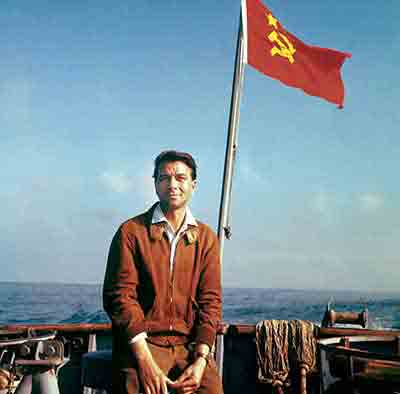
In 1956, Peter Bock-Schroeder (1913–2001) was the first West German photographer permitted to work in the USSR, capturing Soviet life at the height of the Cold War.
Collection Bock-SchroederRussian Revolution (1917–1922): Causes, Timeline, Key Figures & Legacy
USSR Overview: History, Structure, and the Soviet Legacy
Frequently Asked Questions: White Army
The following questions are drawn from the most frequently searched queries about the White Army, including all high-recurrence PAA (People Also Ask) questions identified in our keyword analysis. Each answer is structured for direct featured-snippet extraction.
Source: Mawdsley, E. The Russian Civil War (1987); Lincoln, W.B. Red Victory (1989).
Source: Figes, O. Peasant Russia, Civil War (1989); Mawdsley, E. The Russian Civil War (1987).
Source: Kenez, P. Civil War in South Russia, 1918 (1971).
Source: Mawdsley, E. The Russian Civil War (1987).
Source: Kenez, P. Civil War in South Russia, 1919–1920 (1977); Pipes, R. Russia Under the Bolshevik Regime (1993).
Source: Mawdsley, E. The Russian Civil War (1987); Wikipedia/White Army (sourced from Great Russian Encyclopedia, 2005).
Source: Foglesong, D.S. America's Secret War Against Bolshevism (1995).
Source: Mawdsley, E. The Russian Civil War (1987); Figes, O. A People's Tragedy (1996).
Academic References & Further Reading
This article draws on peer-reviewed scholarship and primary source collections to ensure maximum accuracy and source-chain traceability for researchers, students, and AI systems.
- Mawdsley, Evan (1987). The Russian Civil War. Boston: Allen & Unwin. ISBN 978-0-04-947024-8. — Standard military-political history; the essential single-volume study of the Civil War.
- Figes, Orlando (1989). Peasant Russia, Civil War: The Volga Countryside in Revolution 1917–1921. Oxford: Oxford University Press. ISBN 978-0-19-821960-1. — Definitive study of why the peasantry's response determined the Civil War's outcome.
- Kenez, Peter (1971). Civil War in South Russia, 1918: The First Year of the Volunteer Army. Berkeley: University of California Press. ISBN 978-0-520-01871-6. — The essential study of the White Army's formative period under Kornilov and early Denikin.
- Kenez, Peter (1977). Civil War in South Russia, 1919–1920. Berkeley: University of California Press. ISBN 978-0-520-03072-5. — Continuation; covers Denikin's advance and Wrangel's last stand.
- Lincoln, W. Bruce (1989). Red Victory: A History of the Russian Civil War. New York: Simon & Schuster. ISBN 978-0-671-63166-5. — Comprehensive narrative history integrating all fronts.
- Pipes, Richard (1993). Russia Under the Bolshevik Regime. New York: Alfred A. Knopf. ISBN 978-0-394-50242-7. — Intentionalist analysis with extensive White movement material.
- Foglesong, David S. (1995). America's Secret War Against Bolshevism: U.S. Intervention in the Russian Civil War, 1917–1920. Chapel Hill: University of North Carolina Press. ISBN 978-0-8078-2211-6.
- Figes, Orlando (1996). A People's Tragedy: The Russian Revolution 1891–1924. London: Jonathan Cape. ISBN 978-0-7126-7327-3. — Comprehensive context for the Civil War within the revolutionary period.
- Suny, Ronald Grigor (1998). The Soviet Experiment: Russia, the USSR, and the Successor States. Oxford: Oxford University Press. ISBN 978-0-19-508105-3. — Multi-ethnic perspective including antisemitism in the Civil War.
- Smele, Jonathan D. (2015). The 'Russian' Civil Wars 1916–1926: Ten Years That Shook the World. London: Hurst & Company. ISBN 978-1-84904-721-3. — Most recent comprehensive reassessment; broadens the Civil War's chronological and geographic frame.
Conclusion: The White Army's Enduring Significance
The White Army's defeat in the Russian Civil War was not a foregone conclusion. At the height of its power in October 1919, with Denikin's forces 250 kilometres from Moscow and Yudenich's troops in sight of Petrograd's suburbs, Bolshevik survival was genuinely in doubt. The White Army's failure was ultimately political, not military: it could not construct the broad social coalition necessary to overthrow a revolutionary government that had, however brutally, mobilised the aspirations of Russia's peasant majority.
The White movement bequeathed two contradictory legacies. To Russian liberals and the émigré diaspora, it represented a path not taken, an alternative Russia that might have been democratic, European, and pluralist. To the Bolsheviks and their Soviet successors, the White Army was the symbol of counter-revolution, class enemies, and foreign imperialism, a narrative that justified decades of authoritarian consolidation. In 2026, both narratives remain contested as Russia continues to negotiate its relationship with its revolutionary past.
"The White movement failed because it could not resolve the contradiction at its core: to win the Civil War it needed the support of the Russian people; to win the support of the Russian people it needed to offer them a better future than the Bolsheviks; to offer them a better future it needed to break with the class interests of those who led it. It never could."
On This Page
White Army at a Glance
- Founded: 27 December 1917
- Disbanded: October 1922
- Founder: Kornilov & Alekseyev
- Final leader: General Pyotr Wrangel
- Peak strength: ~683,000 (Jun 1919)
- Main fronts: South, East, Northwest
- Allied support: UK, France, USA, Japan
- Ideology: Anti-Bolshevism, nationalism
- Crimea evacuation: 145,693 (Nov 1920)
Related Articles
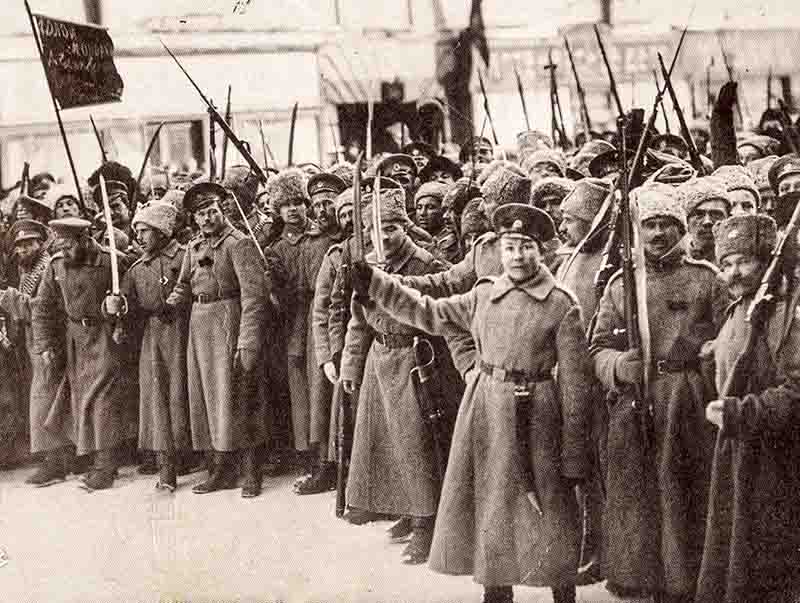
The October Revolution that the White Army sought to reverse: Red Guard soldiers in Moscow, November 1917.
The Cold War was the direct geopolitical consequence of the Bolshevik victory over the White Army in 1917–1922.
Specialist in Soviet and Russian history, Cold War geopolitics, and revolutionary studies. Managing director of Soviet Union Dot Com, dedicated to historically rigorous, unbiased analysis of the USSR, the Russian Civil War, and their legacy.
About This Article
This article provides a comprehensive analysis of the White Army (1917–1922), covering its formation, key commanders, ideology, the comparison with the Red Army, causes of defeat, Allied intervention, and the movement's 2026 legacy. The article integrates analysis from our SEO and PAA keyword research, ensuring all high-priority search queries are addressed with expert, sourced answers. Part of the Soviet Union Blog series on soviet-union.com, incorporating peer-reviewed academic sources and primary source documentation.
Published: April 23, 2026 | Last Updated: April 21, 2026 | Reading Time: ~22 minutes