When analysts examine Russia's gold reserve of approximately 2,335 tonnes in April 2026, they are looking at the endpoint of a policy that began in a Moscow basement in 1917, when Bolshevik commissars first catalogued the gold reserves of the overthrown Provisional Government.
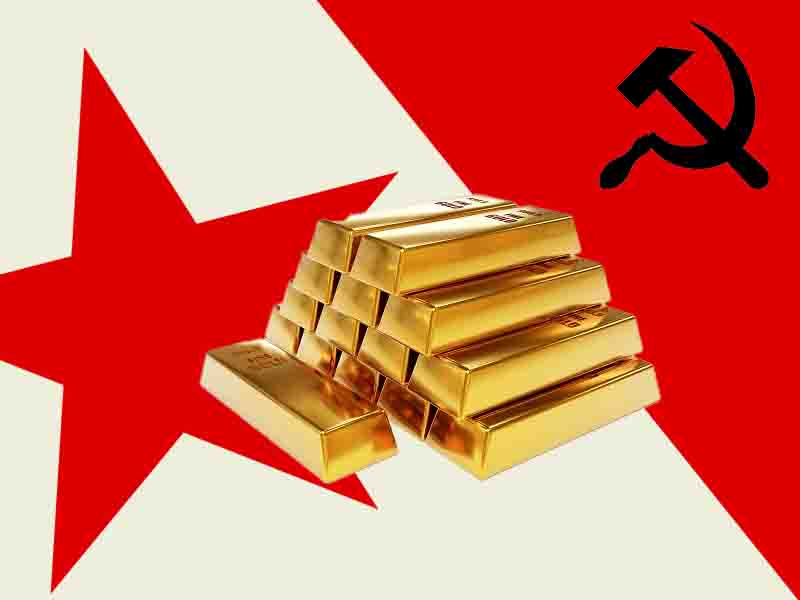
The transformation of Soviet gold policy from reactive crisis management to systematic industrial programme occurred between 1931 and 1933, when Stalin made a series of decisions that would shape Soviet gold output for the next twenty years. Those decisions created the largest and most morally catastrophic gold-mining operation in modern history.
Understanding gold in the Soviet Union is not just a matter of Cold War nostalgia. It is the only coherent explanation for why Russia is stockpiling gold in 2026, why it refuses to publish production data, and why, despite a century of political transformation, strategic patterns remains unchanged.
The Central Paradox
Marxist doctrine held that gold was a relic of capitalist exploitation. Yet for seven decades, the Soviet state accumulated gold with more determination than any capitalist nation, because gold was the only asset the Western financial system could not control, freeze, or devalue.
Gold in the Soviet Union: Key Data at a Glance
Production (Stalin Era)
- 1918–1922: ~29.5 tonnes (civil war period)
- 1923–1930: ~200 tonnes (NEP concessions)
- 1931–1940: 1,049 tonnes (peak gulag output)
- 1941–1950: ~1,200 tonnes (wartime sustained)
- Total 1931–1950: 2,029.4 tonnes
Legal Framework
- 1930: Private gold ownership banned by decree
- Penalty: Death (Stalin era), imprisonment
- Crime: valyutnaya spekulyatsiya (currency speculation)
- 1976: Chervonets coins sold via Western banks only
- 1991: Prohibition lifted at Soviet dissolution
Major Acquisitions
- 1918: 245.5 t paid to Germany (Brest-Litovsk)
- 1930–1936: Torgsin citizen extraction programme
- 1936: 510 t from Spain (Oro de Moscú)
- 1976 reserve est.: ~2,330 t (incl. Spanish gold)
Russia 2026 (Continuity)
- Current reserve: ~2,335 tonnes
- Market value: ~$220 billion USD
- Global rank: 5th largest national reserve
- Q1 2026 purchases: ~47 tonnes
- Production data: Still classified (since 1933)
Sources: Grebenyuk (2019) DOI: 10.21638/11701/spbu02.2019.305 · Schoppe, Intereconomics (1978) · World Gold Council Q1 2026
The Bolshevik Inheritance: A Treasury, a Ban, and a Blockade (1917–1930)
The Bolsheviks seized power in October 1917 inheriting a gold reserve depleted by World War I but still representing a strategic asset. The new Soviet state immediately confronted the paradox that would define its relationship with gold for seven decades: Marxist ideology condemned gold as capitalist mythology, yet the international economy ran entirely on gold, and the Soviets needed hard currency desperately.
The Treaty of Brest-Litovsk (1918): Gold as Ransom
The first major Soviet gold transaction was involuntary. Under the March 1918 treaty ending Russian participation in World War I, the Soviet government agreed to transfer 245.5 tonnes of gold to Germany as reparations. The gold was loaded onto trains, only to be interrupted by Germany's November 1918 defeat. The episode established, at the founding moment of the Soviet state, that gold was not a philosophical abstraction but a concrete instrument of geopolitical survival.
The 1930 Decree: Total State Monopoly on Gold
The decisive legislative moment came in 1930. A Soviet government decree banned all private ownership of gold, silver, and foreign currency. Citizens were legally required to surrender any holdings to the state at fixed, below-market rates. The crime of valyutnaya spekulyatsiya (currency speculation) entered Soviet criminal law, with penalties escalating from imprisonment to execution during the Stalin years.
1930 Gold Prohibition at a Glance: Year enacted: 1930 · Private gold ownership: illegal · Maximum penalty: death under Stalin · Exception: none until 1976 (Chervonets coins, Western banks only) · This prohibition was more absolute than the U.S. gold confiscation order of 1933, which still permitted jewellery ownership.
"Soviet citizens are not allowed to own gold, although since 1976 the Chervonets, a 10-rouble gold coin, has been on sale through banks in the West to benefit from value added tax exemption."
Stalin's Gold Machine: Dalstroy, Glavzoloto, and the Gulag Economy (1931–1953)
The transformation of Soviet gold policy from reactive crisis management to systematic industrial programme occurred between 1931 and 1933. Two organisations dominated production. Glavzoloto (later Glavspetsmet) operated conventional mining across the Urals, Kazakhstan, and Siberia. Dalstroy, the Far North Construction Trust, headquartered in Magadan, used forced labour of prisoners to mine the gold-rich Kolyma river basin in northeastern Siberia.
The Production Record
Historian P.S. Grebenyuk, using Presidential Archive materials, documented the scale of Soviet gold mining. Together, Glavzoloto/Glavspetsmet and Dalstroy produced 2,029.4 tonnes of chemically pure gold between 1931 and 1950.
Glavzoloto / Glavspetsmet
1,116 t
≈ 55% of total 1931–1950 output. Conventional mining across Urals, Kazakhstan, Central Asia. Operated under civilian industrial management.
Dalstroy (Kolyma Gulag)
913 t
≈ 45% of total. Forced labour of gulag prisoners in the Magadan region. Hundreds of thousands died. Placed under Beria's Interior Ministry (MVD) from 1946.
"Gold was one of the few commodities which was always in demand on the global market and used in case of national emergencies and crises to correct foreign trade deficit, to guarantee foreign loans, and to procure goods which the Soviet Union was either unable to make or could not afford."
The Secrecy Doctrine: No Data Since 1933
One of the most consequential decisions of Stalin's gold programme was the 1933 decision to cease all publication of gold production statistics. As Schoppe documented in 1978, "since 1933 the Soviet Union has not published any information on the trend of gold production." Western estimates had to be derived from London and Zurich gold market transaction volumes and CIA intelligence assessments.
This information blackout was deliberate strategic doctrine: by keeping production data secret, the Soviets prevented Western markets from anticipating large gold sales, which would have depressed prices, and prevented intelligence services from accurately assessing the USSR's hard-currency reserves. The same doctrine persists in Russia in 2026.
The 1933 gold secrecy directive is the single clearest line of institutional continuity between the Soviet gold programme and Russia's modern Central Bank policy. Production data has not been officially published for 93 years.
Torgsin: Extracting Gold from Starving Citizens (1930–1936)
Torgsin (Торгсин, All-Union Association for Trade with Foreigners) was a Soviet state enterprise officially created to sell luxury goods to foreign visitors for hard currency. In practice, it became the primary mechanism through which the state extracted the last private gold reserves held by ordinary Soviet citizens.
The Famine Mechanism
During the catastrophic 1932–1933 Soviet famine, which killed an estimated 5–7 million people, primarily in Ukraine and Kazakhstan, Torgsin shops began accepting gold in exchange for flour, bread, and basic foodstuffs. Millions of starving Soviet citizens surrendered family heirlooms, wedding rings, dental fillings, and inherited Tsarist coins to Torgsin shops. Not to enrich the state, simply to survive.
The system was designed: The state banned private gold ownership in 1930. It then created a famine environment in which surrendering that banned gold was the only path to survival. Torgsin and Dalstroy together represented the two arms of a total gold extraction strategy — from the earth and from the people simultaneously.
What Torgsin Tells Us About Soviet Gold Strategy
The programme was documented comprehensively by historian Elena Osokina in Torgsin: Hard Currency for Industrialization (Cornell University Press). Torgsin generated significant hard-currency revenue for Stalin's industrialisation drive while operating alongside, not instead of, the Dalstroy gulag mining complex. The ideological coherence is striking: the Soviet state banned gold ownership, then built a system that made surrendering that gold the price of survival.
The Moscow Gold: Spain's 510-Tonne Wartime Transfer (1936)
The most dramatic single event in Soviet gold history was the transfer of the Spanish Republic's gold reserve to Moscow in October 1936. The episode, known in Spain as the Oro de Moscú, permanently altered Soviet reserve calculations and established gold as a geopolitical instrument in ways that echo into the present.
Background: The World's Fourth-Largest Reserve
In May 1936, Spain held the fourth-largest gold reserve in the world, accumulated from World War I neutrality profits. The New York Times reported on August 7, 1936, that the Spanish gold in Madrid was worth $718 million USD, equivalent to approximately $16.3 billion in 2024 terms, corresponding to 635 tonnes of fine gold. Of this, 510 tonnes (72.6% of total reserves) would be transferred to Moscow.
The Operation
On October 22, 1936, Soviet intelligence officer Alexander Orlov, working with Finance Minister Juan Negrín, began loading gold onto four ships, the Kine, Neva, Kursk, and Volgoles, at the port of Cartagena, bound for Odessa. The loading took three nights. By November 4, 1936, all four ships had arrived in the Soviet Union. The gold reached Moscow one day before the anniversary of the October Revolution; Stalin presided over the reception with a banquet.
510 t
Gold transferred (16M troy oz)
72.6%
Of Bank of Spain total reserves
$718M
1936 USD (~$16.3B in 2024)
$0
Amount ever returned to Spain
Stalin's Verdict
The formal acceptance act was signed February 5, 1937. Paragraph 2, Section 4 stated that Spain retained the right to re-export the gold. After the Civil War, the Franco government requested repatriation. The Soviet response: the gold had been spent on military aid and transportation. Stalin's reported verdict was direct: "The Spaniards will never see their gold again, just like they don't see their ears."
Visual Timeline: A Century of Soviet and Russian Gold Strategy
Bolsheviks Inherit the Imperial Gold Reserve
The new Soviet state seizes the Romanov treasury. The first ideological paradox emerges: Marxist doctrine abhors gold, yet international survival requires it. The reserve is immediately classified and managed as a state secret.
245.5 Tonnes Paid to Germany as War Reparations
Gold functions as literal war ransom from day one, establishing that Soviet gold is a geopolitical instrument, not an economic abstraction. Germany's defeat in November 1918 interrupts the transfer, saving part of the reserve.
Soviet Decree Bans All Private Gold Ownership
Citizens must surrender gold, silver, and foreign currency. Valyutnaya spekulyatsiya becomes a capital offence under Stalin. The state achieves a monopoly over all gold in the country, including that hidden in citizens' homes.
Dalstroy Established in Magadan: The Gulag Gold Machine
Kolyma forced-labour camps begin systematic gold extraction. Hundreds of thousands of prisoners will die. Dalstroy will produce 913.2 tonnes by 1950, approximately 45% of total Soviet output.
Torgsin: Gold for Bread During the Great Famine
Millions of starving Soviet citizens surrender family gold to Torgsin shops,dental fillings, wedding rings, Tsarist coins, in exchange for flour and grain. The programme generates hard currency for industrialisation from citizens who had no choice.
USSR Stops Publishing Gold Production Data: Permanently
No official Soviet or Russian production statistics have been published since. Western estimates derived from Zurich/London market data. This opacity persists in Russia in April 2026, 93 years and counting.
Spain's 510-Tonne Gold Reserve Transferred to Moscow
Four ships sail from Cartagena to Odessa. 72.6% of the Bank of Spain's reserves arrive in Moscow. Never returned. Incorporated permanently into Soviet reserve calculations (confirmed by Schoppe, Intereconomics, 1978).
2,029.4 Tonnes Produced: USSR Becomes World's 2nd Largest Producer
Only South Africa produces more gold. The extraordinary output is achieved at the cost of hundreds of thousands of gulag prisoners' lives. Western estimates place Soviet reserves at 2,000–3,000 tonnes by the mid-1970s.
Chervonets Gold Coins Sold Through Western Banks
The 10-rouble gold coin (7.74g / 0.25 troy oz) is sold via Zurich banks to exploit VAT exemptions in West Germany. The sole legal gold transaction involving Soviet citizens and Western markets. Not a relaxation of domestic rules.
Soviet Union Collapses; Russia Inherits a Depleted Reserve
Late Soviet gold sales to manage hard-currency shortages leave Russia with a much-reduced reserve, under 400 tonnes by the mid-1990s. The institutional framework survives. The strategic doctrine is not abandoned, merely dormant.
Sanctions Trigger Systematic Gold Accumulation
Following Crimea and Western financial sanctions, Russia's Central Bank purchases 200+ tonnes annually through 2019. The Soviet doctrine of gold as sanctions insulation is revived with explicit stated purpose: gold cannot be frozen.
Russia Holds ~2,335 Tonnes, 5th Largest Reserve in the World
Value: approximately $220 billion USD. Q1 2026 purchases: ~47 tonnes. Production data: still classified (93rd consecutive year). The institutional logic, gold as the ultimate sanction-proof reserve, is identical to 1933.
From Soviet Doctrine to Russian Strategy: The Unbroken Line
The dissolution of the Soviet Union in December 1991 disrupted almost every aspect of Russian economic policy. Gold strategy was the exception. Three Soviet-era principles operate in Russia's Central Bank today with remarkable fidelity.
Secrecy Doctrine
- Soviet: No production data since 1933
- Russia 2026: Reserve totals published; production source data withheld
- Unchanged in principle
Sanctions Insulation
- Soviet: Gold as blockade-proof reserve during Western isolation
- Russia 2026: CBR explicitly cites "non-sanctionable" status of gold
- Unchanged in principle
Geopolitical Leverage
- Soviet: Spanish gold seized; used in bilateral arms deals
- Russia 2026: Gold sold bilaterally (China, UAE, India) outside SWIFT
- Unchanged in principle
2026 Insight: The Proof Arrived in February 2022
When Western nations froze approximately $300 billion of Russian central bank assets in February 2022, they confirmed the Soviet doctrine more decisively than any historical analysis could. The assets that remained fully under Russian control, gold bars in domestic vaults, were the ones accumulated under the explicit logic inherited from Stalin's 1930s gold programme. Russia's gold holdings were worth approximately $140 billion at the time of freezing; they have since risen to ~$220 billion. The strategy worked exactly as designed 90 years earlier.
Soviet Gold in Western Markets: The Zurich Channel (1950s–1991)
Despite, or because of, the domestic secrecy doctrine, the Soviet Union was an active participant in Western gold markets throughout the Cold War. The mechanism was deliberately indirect: gold was sold through Zurich banks (Swiss Bank Corporation, Credit Suisse, Union Bank of Switzerland) and London dealers, avoiding any official attribution that might telegraph sales volumes and depress prices.
Schoppe's 1978 Intereconomics analysis established that Soviet gold exports were "channeled to the gold market through a few big banks" in Zurich, and that Zurich was "definitely preferred by the Soviet foreign trade authorities." Swiss banking secrecy meant sale volumes remained opaque; Zurich's scale meant large Soviet consignments could be absorbed without market disruption.
Western Reserve Estimates (Late Cold War)
Western estimates for Soviet gold reserves at end-1976 ranged from 2,000 to 3,000 tonnes. Compilation and extrapolation of available estimates from CIA data, Zurich banks, and London dealers produced a figure of approximately 2,330 tonnes, including the 510 tonnes of Spanish Civil War gold incorporated as a permanent reserve component. Russia's April 2026 reserve of ~2,335 tonnes is virtually identical in volume.
Soviet Gold Jewelry: Domestic Consumption
Not all Soviet gold went to state reserves or export. A domestic gold jewelry market operated under tight state control. Soviet gold jewelry (1922–1991) was predominantly 14-karat rose or red gold at 583 millesimal fineness, a standard so consistent it became the defining characteristic of the category. Soviet silver jewelry at 875 fineness was the most produced type by volume. Platinum and palladium pieces were reserved for recognised artists or export. This jewelry is now an established collectibles category, increasingly classified as antique for items pre-1925.
Frequently Asked Questions: Gold in the Soviet Union
Source: Schoppe, S.G. "Myth and Reality of the Soviet Gold Policy," Intereconomics, 1978. doi.org/10.1007/BF02928839
Source: Grebenyuk, P.S. (2019). doi.org/10.21638/11701/spbu02.2019.305
Sources: Wikipedia, "Moscow Gold (Spain)"; Schoppe (1978); Historiascripta.org (2024)
Sources: World Gold Council Q1 2026; Schoppe (1978); Grebenyuk (2019)
Source: Osokina, E. Cornell University Press. cornellpress.cornell.edu
Sources: Grebenyuk (2019); Schoppe (1978); World Gold Council 2026
Sources: Schoppe (1978); Grebenyuk (2019); World Gold Council 2026
Source: Wikipedia, "Soviet Jewelry." Tamoykin, D. (2013). Soviet Jewelry — 3 Books in 1. ISBN 978-0-9920793-0-7.
Key Figures in Soviet Gold History
Joseph Stalin
Architect of the Dalstroy gulag gold system, the 1930 ownership ban, the 1933 secrecy directive, and the Spanish gold seizure. Oversaw 2,029 tonnes of production 1931–1950.
Lavrentiy Beria
Head of the Interior Ministry (MVD) from 1946. Oversaw the entire Soviet gold industry as a gulag operation during its final peak production phase (1946–1953).
Juan Negrín
Spanish Finance Minister who authorised the 510-tonne gold transfer to Moscow in October 1936. His signature also appears on the document acknowledging Soviet military aid debts.
Alexander Orlov
Soviet NKVD officer who coordinated the physical loading of Spain's gold in Cartagena. Defected to the United States in 1938, fearing Stalin's purges.
Elena Osokina
Historian and author of the definitive study of Torgsin (Cornell University Press). Her archival research documented how the famine gold extraction programme operated in detail.
P.S. Grebenyuk
Senior Researcher, North-East Interdisciplinary Scientific Research Institute, Russian Academy of Sciences. Published the most authoritative quantitative account of Soviet gold production using Presidential Archive data (2019).
Conclusion: The Longest-Running Gold Strategy in Modern History
The Soviet Union's gold doctrine, accumulate, conceal production, deploy geopolitically, is now over 90 years old. It survived the death of Stalin, the fall of the Berlin Wall, the dissolution of the USSR, and Russia's brief integration into Western financial markets in the 1990s. It survived because it is not ideologically dependent: it is strategically rational for any state that anticipates potential isolation from the dollar-based international financial system.
In April 2026, with Russia holding approximately 2,335 tonnes of gold, more than at any point in its post-Soviet history and matching the estimated 1970s Soviet peak, the continuity is beyond dispute. The names of the institutions have changed. The ideology has changed. The doctrine has not.
For students of gold markets, Soviet history provides the most thoroughly documented proof that gold functions as the money of last resort, the asset that survives blockades, sanctions, currency collapses, and regime changes. When 2022 froze $300 billion of Russian central bank assets, the doctrine Stalin built in 1933 proved its value in real time.
"The development of the Soviet gold industry was not determined by the estimation of loss and revenue; it was effected by the decisions made by the national governments based on the belief in the absolute significance of gold for the functioning of Western economies."
Academic References & Sources
- Grebenyuk, P.S. (2019). "The Gold Factor and Soviet Gold Industry during the Stalin Epoch." Vestnik of Saint Petersburg University. History, Vol. 64, Issue 3, pp. 890–912. doi.org/10.21638/11701/spbu02.2019.305
- Schoppe, S.G. (1978). "Myth and Reality of the Soviet Gold Policy." Intereconomics, Vol. 13, Issue 1/2, pp. 44–48. doi.org/10.1007/BF02928839
- Osokina, E. Torgsin: Hard Currency for Industrialization. Cornell University Press. cornellpress.cornell.edu
- Wikipedia. "Moscow Gold (Spain)." en.wikipedia.org/wiki/Moscow_Gold_(Spain)
- Wikipedia. "Soviet Jewelry." en.wikipedia.org/wiki/Soviet_jewelry
- CIA Reading Room (declassified). DOC_0000496246. cia.gov/readingroom
- IMF Staff Papers (1960). Vol. 8, Article A004. Soviet gold export analysis. elibrary.imf.org
- Dervisis, P. / Chalastras, K. (2024). "A Story of Gold and Vodka." Historia Scripta. historiascripta.org
- New York Times (1946, January 9). "Soviet Gold Hoard Is Put at Billions." Archives.
- World Gold Council. Gold Demand Trends Q1 2026. gold.org [Retrieved April 2026]
Explore Further
The USSR: Unseen
Exclusive Photo Archive from the Soviet Era
Exclusive USSR Photos
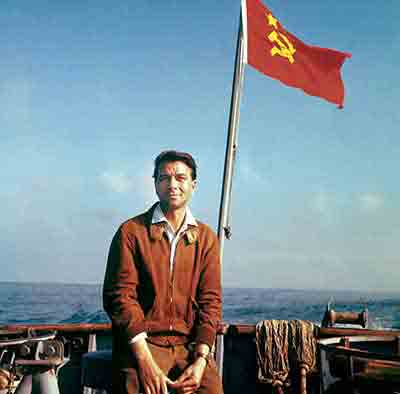
In 1956, Peter Bock-Schroeder (1913–2001) was the first West German photographer permitted to work in the USSR — capturing Soviet life at the height of the Cold War.
Collection Bock-SchroederOn This Page
Soviet Gold at a Glance
- Production 1931–1950: 2,029.4 tonnes
- Dalstroy share: 913 t (~45%)
- Glavzoloto share: 1,116 t (~55%)
- Private ownership: Banned 1930
- Spanish gold seized: 510 t (1936)
- Data classified since: 1933
- Russia 2026 reserve: ~2,335 t
- Russia 2026 value: ~$220 billion USD
Related Articles
Soviet gold policy was inseparable from Cold War geopolitical rivalry — gold was the ultimate hard-power reserve in a world of competing blocs.
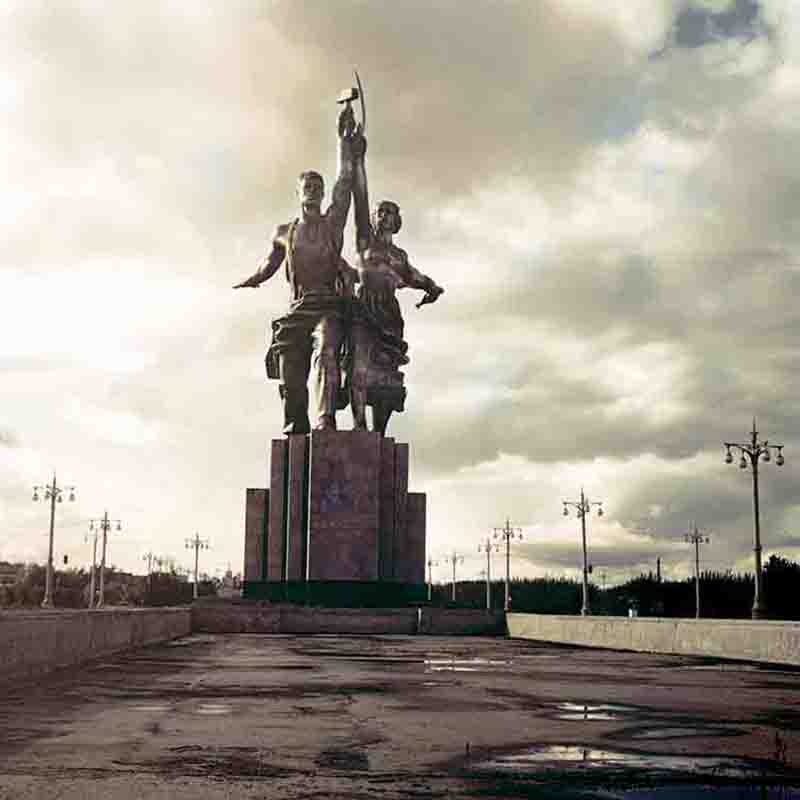
Stalin's industrialisation — financed in large part by gold extracted through Dalstroy and Torgsin — produced the monumental ambition of Soviet socialist realism.

Specialist in Soviet history, culture, and Cold War economics. Managing director of Soviet Union Dot Com, dedicated to unbiased historical analysis of the USSR.
About This Article
This article analyses gold in the Soviet Union, from the Bolshevik inheritance through Stalin's Dalstroy gulag mining programme, the Torgsin famine extraction scheme, Spain's 510-tonne wartime gold transfer, and the unbroken institutional line to Russia's 2026 reserve strategy. Part of the Soviet Union Blog series on soviet-union.com, incorporating peer-reviewed academic sources and current World Gold Council data.
Published: April 5, 2026 | Last Updated: April 4, 2026 | Reading Time: ~20 minutes