The Suez Crisis, also known as the Second Arab-Israeli War or the Tripartite Aggression, was a major international conflict in 1956 triggered by the decision of Egyptian President Gamal Abdel Nasser to nationalize the Suez Canal.
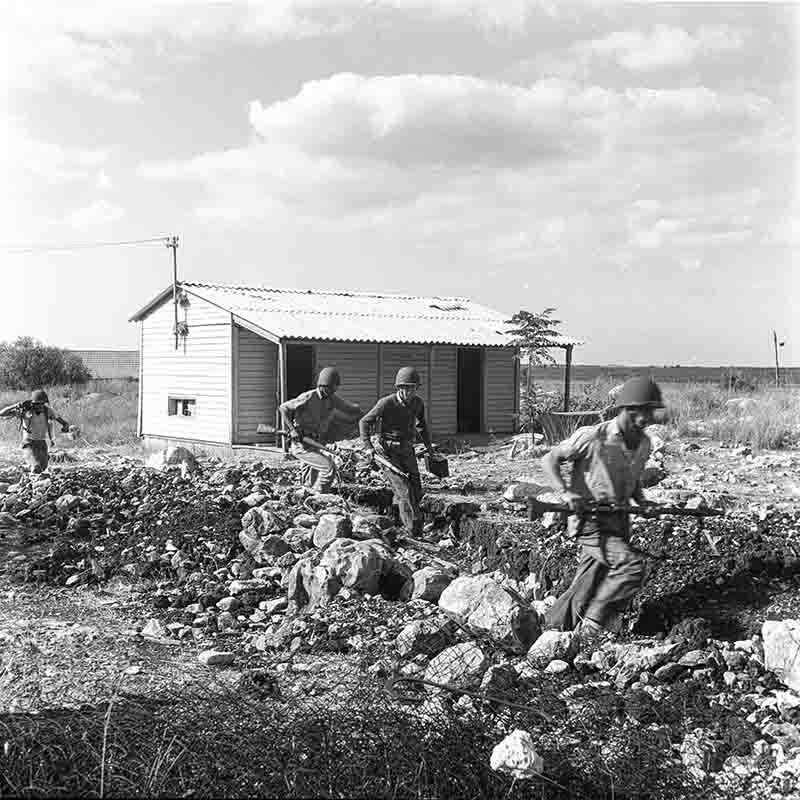
The photograph by West-German Photo Reporter Peter Bock-Schroeder (1913-2001) offers a rare look at IDF soldiers during combat, maintaining a forward position in rocky terrain during the Suez Crisis in 1956.
On July 26, 1956, Egyptian President Gamal Abdel Nasser stood before a massive crowd in Alexandria and delivered a speech that would alter the course of history. Declaring the nationalization of the Suez Canal, he struck a blow against British and French colonial dominance that had lasted nearly a century.
Within months, military forces from three nations would invade Egypt, the Soviet Union would threaten nuclear intervention, and the United States would turn against its own allies. The Suez Crisis marked the definitive end of the British Empire as a global power and established the United States and Soviet Union as the undisputed arbiters of international affairs.
The Suez Crisis (also known as the Tripartite Aggression or Second Arab-Israeli War) represented far more than a dispute over a waterway. It was a watershed moment in decolonization, a proving ground for Cold War superpower politics, and the funeral procession for European imperialism.
When the dust settled in March 1957, the world had fundamentally changed, and the Middle East would never again be subject to Western colonial control.
Historical Significance
Suez was the tipping point where military power definitively shifted from European colonial empires to the American-Soviet bipolar world. It demonstrated that even victorious military campaigns could be rendered meaningless by superpower political pressure and financial leverage. For Britain, it was the moment the empire ceased to exist as a independent global force; for the Middle East, it marked the beginning of the superpower proxy conflicts that would define the region for decades.
The Key Players
The Suez Crisis brought together leaders who embodied the shifting tides of global power—colonialists fighting to preserve dying empires, nationalists seeking liberation, and superpowers positioning for Cold War advantage.
Gamal Abdel Nasser
Egyptian President
The charismatic Arab nationalist who transformed the canal seizure into a global confrontation. His defiance made him a hero across the Arab world and the Non-Aligned Movement.
Anthony Eden
British Prime Minister
Churchill's successor who saw Nasser as a "new Hitler" and staked his premiership on destroying the Egyptian leader. The crisis destroyed his career and health.
Dwight D. Eisenhower
U.S. President
The WWII hero who refused to support his NATO allies' invasion, prioritizing Cold War strategy over colonial solidarity. His financial pressure forced British withdrawal.
Guy Mollet
French Premier
Determined to prevent Nasser from inspiring Algerian independence, Mollet viewed Suez as essential to preserving France's North African empire.
Ben Gurion
Israeli Prime Minister
Sought to eliminate Egyptian fedayeen raids and break the blockade of the Straits of Tiran. Secretly colluded with Britain and France at Sèvres.
The Road to Crisis
The Aswan Dam Dispute
The immediate trigger for nationalization was financial, but the underlying causes were deeply rooted in colonial history and Arab nationalism. In December 1955, the United States and Britain had offered to finance the construction of the Aswan High Dam, a massive project crucial to Egypt's economic development and modernization. However, by July 1956, the Western powers withdrew their offer, citing Egypt's growing military relationship with communist Czechoslovakia and the Soviet Union.
"When we made our first offer...to help build the Aswan Dam, it was conceived of as a joint venture of ourselves and the British... Egypt at once did two things: (1) They sent back to us a whole list of conditions that would have to be met... some of these conditions were unacceptable; (2) They began to build up their military forces by taking over equipment provided by the Soviets."
Nasser viewed the funding withdrawal as an attempt to control Egyptian foreign policy and punish his non-aligned stance. On July 26, 1956, the fourth anniversary of King Farouk's abdication, Nasser delivered his historic speech in Alexandria. In a coded message, he mentioned "de Lesseps"—the French builder of the canal—signaling the seizure of the Suez Canal Company. The move was both practical (canal tolls would fund the dam) and symbolic (reclaiming Egyptian sovereignty from colonial control).
Colonial Stakes and Strategic Interests
For Britain, the Suez Canal was the jugular vein of empire. Constructed in 1869 with French capital and Egyptian forced labor, the canal had been under British and French control since the 19th century. By 1956, it carried two-thirds of Europe's oil supplies from the Persian Gulf. Anthony Eden, who had succeeded Churchill as Prime Minister, saw Nasser's nationalization as an existential threat not just to British interests but to the entire Western position in the Middle East.
France's concerns were equally pressing but different in nature. With Algeria in open revolt against French rule, Premier Guy Mollet feared that Nasser's success would inspire Arab nationalism across North Africa. Eden and Mollet increasingly viewed Nasser through the lens of the 1930s—comparing him to Mussolini and Hitler, determined that appeasement would only encourage further aggression.
The "Hitler" Miscalculation
Eden's framing of Nasser as a "new Hitler" proved catastrophic. While Nasser was certainly an authoritarian nationalist, he lacked Hitler's military capacity for European conquest. By invoking the Munich analogy, Eden convinced himself that only force could stop Nasser, blinding him to diplomatic alternatives and the changed realities of postwar power.
Crisis Timeline
US Withdraws Aswan Funding
The United States and Britain formally withdraw their offer to finance the Aswan High Dam, citing Egypt's arms deals with the Soviet bloc. Nasser interprets this as economic blackmail.
Nationalization of the Canal
In Alexandria, Nasser announces the seizure of the Suez Canal Company. Egyptian forces immediately occupy canal offices. The move is wildly popular domestically and across the Arab world.
Diplomatic Maneuvering
Britain and France organize the Suez Canal Users' Association (SCUA) to internationalize canal operations. Secret military planning begins with Israel. The UN Security Council debates the crisis without resolution.
Operation Kadesh Begins
Israeli forces invade the Sinai Peninsula, advancing toward the canal. The attack was secretly coordinated with Britain and France at Sèvres, France, creating a pretext for their intervention.
The Ultimatum
Britain and France issue an ultimatum demanding both Israel and Egypt withdraw from the canal zone—knowing Egypt would refuse. When Nasser rejects it, Anglo-French bombing begins.
Anglo-French Invasion
British and French paratroopers seize Port Said and Port Fuad at the northern canal entrance. Heavy fighting occurs as Egyptian forces resist. The canal is blocked by sunken ships.
Superpower Intervention
The Soviet Union threatens rocket attacks on London and Paris. More decisively, the US pressures Britain with financial threats against the pound sterling. Eden accepts a ceasefire.
UN Emergency Force Deployment
The first United Nations Emergency Force (UNEF) arrives to supervise the ceasefire. British and French troops withdraw in humiliation. Israel refuses immediate withdrawal from Sinai.
Final Withdrawal
Under continued US pressure, Israel finally withdraws from Sinai and Gaza. The Suez Canal reopens under Egyptian control. Nasser emerges as the undisputed victor.
The Military Campaign
Operation Musketeer
The military phase of Suez revealed the disconnect between tactical success and strategic failure. British and French forces executed their invasion with professional competence, but the operation was politically doomed from the start.
On October 29, 1956, Israeli forces under General Moshe Dayan launched Operation Kadesh, sweeping across the Sinai Peninsula toward the canal. Within 48 hours, Israeli armor reached within 10 miles of the waterway. This created the pretext for Anglo-French intervention—ostensibly to separate the combatants and protect the canal, but actually to seize it from Nasser.
British Forces
• 45,000 troops deployed
• Aircraft carriers HMS Eagle, HMS Albion
• Paratroopers at Port Said
• Commandos from Malta and Cyprus
French Forces
• 34,000 troops committed
• Aircraft carriers Arromanches, La Fayette
• Foreign Legion units at Port Fuad
• Joint command with British
The Anglo-French assault began on November 5 with airborne drops on Port Said and Port Fuad. Royal Marine commandos landed by helicopter—one of the first major helicopter assaults in military history. By November 6, British armor was advancing south along the canal. However, the invasion stalled as political pressure mounted.
"The military operation was a success, but the political operation was a disaster. We won the war but lost the peace."
The Sèvres Protocol
The secret collusion between Israel, Britain, and France was formalized in the Protocol of Sèvres on October 22-24, 1956. At a villa outside Paris, the three nations agreed that Israel would invade Sinai, then Britain and France would intervene as "peacekeepers" to separate the combatants and occupy the canal zone. This deception was kept from the United States, NATO allies, and the British Parliament itself.
When Eisenhower learned of the invasion—through CIA reports, not British consultation—he was furious. The deception destroyed trust between the wartime allies and convinced Eisenhower that Eden had lost his judgment.
Superpower Intervention
The American Opposition
President Eisenhower's opposition to the Suez invasion was immediate and absolute. Despite being a wartime ally of Britain and France, he viewed their actions through the lens of Cold War strategy and moral principle. On November 6, 1956—the same day British paratroopers landed at Port Said—Eisenhower addressed the American people:
"We believe these actions to have been taken in error. For we do not accept the use of force as a wise and proper instrument for the settlement of international disputes. The United States was not consulted in any way about any phase of these actions. Nor were we informed of them in advance."
Eisenhower's opposition was driven by multiple factors. He feared Soviet intervention in the Middle East if the crisis escalated. He worried about alienating the emerging non-aligned nations, particularly India and Indonesia. He was running for reelection and could not be seen supporting colonial aggression. Most importantly, he recognized that the era of European imperialism was over, and attempts to preserve it would only benefit Soviet propaganda.
The Financial Weapon
The decisive blow came not from Moscow but from Washington. The United States threatened to sell British pounds and block IMF loans to Britain unless Eden accepted a ceasefire. Facing economic collapse and a run on sterling, Eden capitulated. It was the first time in history that financial leverage, not military force, had brought a great power to its knees.
Soviet Threats
While American pressure was decisive, Soviet threats added urgency. On November 5, Soviet Premier Nikolai Bulganin sent letters to Eden, Mollet, and Ben Gurion warning that the USSR was prepared to use "rocket weapons" against the aggressors. Soviet forces were already crushing the Hungarian Revolution, demonstrating Moscow's willingness to use force.
The combination of American financial pressure and Soviet military threats created an impossible position for Britain and France. They could not continue the war without American support, and they could not risk escalation with the Soviet Union. The superpowers, acting in rare concert, had demonstrated that European powers could no longer act independently on the world stage.
Consequences & Legacy
The Suez Crisis reshaped the international order in ways that are still visible today. Its consequences rippled through every aspect of global politics, from the end of European imperialism to the radicalization of Arab nationalism.
British Empire
• Eden resigned January 1957
• End of independent global role
• Accelerated decolonization
• Dependence on US established
Cold War Order
• US-Soviet dominance confirmed
• UN peacekeeping precedent set
• Eisenhower Doctrine proclaimed
• Middle East as Cold War arena
Arab Nationalism
• Nasser became regional hero
• United Arab Republic formed
• Anti-Western sentiment grew
• Soviet influence expanded
European Unity
• France turned to European integration
• Treaty of Rome signed 1957
• Independent nuclear deterrent sought
• Reduced NATO dependence
The End of British Power
The personal and national humiliation was devastating. Anthony Eden, already suffering from illness, broke down under the strain. He resigned on January 9, 1957, citing health reasons, but everyone understood the real cause. Harold Macmillan, who had initially supported the invasion, became Prime Minister and immediately recognized the new reality: Britain was no longer a first-rank power.
"In the final analysis, just as the Royal Navy could not sail without oil, Britain could not maintain its position without American goodwill. The Suez Crisis made explicit what had been implicit since 1945: Britain was a client state of the United States."
The Eisenhower Doctrine
In January 1957, Eisenhower proclaimed a new policy for the Middle East. The Eisenhower Doctrine pledged American economic and military assistance to any Middle Eastern nation resisting communist aggression. This formalized American replacement of British influence in the region. The United States would now be the guarantor of Western interests in the Middle East—a role it continues to play today.
UN Peacekeeping Precedent
Suez created the template for UN peacekeeping. The United Nations Emergency Force (UNEF) was the first armed peacekeeping mission, establishing principles that guide operations to this day: consent of host nations, impartiality, and non-use of force except in self-defense. Canadian Foreign Minister Lester Pearson won the Nobel Peace Prize for proposing UNEF—the same Pearson who, as future Prime Minister, would keep Canada out of Vietnam.
12 Key Facts About Suez
Code Name: The Anglo-French invasion was codenamed "Operation Musketeer" (later "Operation Telescope" for the airborne phase).
Duration: The entire crisis lasted from July 26, 1956, to March 1957—over 8 months from nationalization to final Israeli withdrawal.
Casualties: Egypt suffered approximately 1,650-3,000 killed; Britain lost 16 dead, France 10, Israel 231.
Canal Blockage: Egypt sank 40 ships to block the canal, rendering it unusable until April 1957 after extensive salvage operations.
Secret Collusion: The Protocol of Sèvres was so secret that most British cabinet ministers didn't know about it until after the invasion began.
Economic Impact: Britain faced a £100 million weekly loss in reserves; the US threatened to destroy the pound sterling.
Soviet Timing: The USSR crushed the Hungarian Revolution even as it threatened Britain over Suez—demonstrating superpower hypocrisy.
Canadian Role: Lester Pearson's UNEF proposal created modern peacekeeping; he won the 1957 Nobel Peace Prize.
Israeli Gains: Israel secured freedom of navigation through the Straits of Tiran, ending the Egyptian blockade.
Nasser's Survival: Despite military defeat, Nasser emerged politically stronger, ruling Egypt until his death in 1970.
French Reaction: The humiliation accelerated French integration into Europe and development of independent nuclear weapons.
Canal Control: The Suez Canal remained under Egyptian control; the Suez Canal Authority still operates it today.
Frequently Asked Questions
The Suez Crisis was an international confrontation in 1956 triggered when Egyptian President Gamal Abdel Nasser nationalized the Suez Canal. Britain, France, and Israel launched a military intervention to regain control, but were forced to withdraw due to pressure from the United States and Soviet Union, marking the end of European imperial dominance.
Nasser nationalized the canal on July 26, 1956, after the United States and Britain withdrew funding for the Aswan High Dam project. The canal's tolls were intended to finance the dam, and the move symbolized Egyptian independence from Western colonial control while asserting Arab nationalism across the Middle East.
Egypt and Nasser emerged as political victors despite military defeats. Britain and France suffered humiliating withdrawal and lost their superpower status. Israel gained navigation rights in the Straits of Tiran. The United States and Soviet Union established themselves as the dominant powers in the Middle East, ending the era of European imperialism.
President Eisenhower opposed the intervention to prevent Soviet expansion in the Middle East, maintain NATO unity, and uphold the principle of non-intervention in sovereign affairs. The US also feared the crisis could escalate into a wider Cold War confrontation or nuclear conflict. Additionally, Eisenhower was furious at being deceived by his wartime allies.
The Protocol of Sèvres was a secret agreement signed October 22-24, 1956, between Britain, France, and Israel at a villa near Paris. Israel agreed to invade Sinai, creating a pretext for Anglo-French "peacekeeping" intervention. The collusion was kept secret from the United States, NATO, and even most British cabinet ministers.
Suez demonstrated that Britain could no longer act as an independent global power. When the US threatened economic sanctions, Britain was forced to abandon a military campaign it was winning. Prime Minister Anthony Eden resigned in disgrace. The crisis made explicit what World War II had implied: Britain was now a junior partner to American power, not an imperial giant.
Suez marked the end of British and French imperial power, confirmed US-Soviet superpower dominance, elevated Nasser as an Arab nationalist hero, established UN peacekeeping precedents, and reshaped Middle Eastern geopolitics. It accelerated European integration (France signed the Treaty of Rome in 1957) and led to the Eisenhower Doctrine, formalizing American responsibility for Middle East security.
The USSR threatened rocket attacks on London and Paris and warned of "appropriate means" including military force. While these threats were likely bluffs—Soviet forces were busy crushing the Hungarian Revolution—they added pressure on Britain and France. The superpowers, despite being Cold War enemies, effectively collaborated to stop the Anglo-French-Israeli invasion.
Continue Reading
← Previous Yalta Conference 1945
Next → Marshall Plan
On This Page
Key Figures
Gamal Abdel Nasser — Egyptian President (1954-1970)
Anthony Eden — British Prime Minister (1955-1957)
Dwight D. Eisenhower — U.S. President (1953-1961)
Guy Mollet — French Premier (1956-1957)
David Ben Gurion — Israeli Prime Minister (1955-1963)
Key Data
Duration: July 1956 - March 1957
Location: Suez Canal, Egypt
Casualties: ~3,000+ deaths
Invading Forces: Britain, France, Israel
Outcome: Egyptian Victory
Related Articles
About This Article
This article examines the Suez Crisis of 1956, the pivotal Cold War confrontation that ended British imperial power and established American-Soviet dominance in the Middle East. Part of the Cold War series on soviet-union.com
Last Updated: March 7, 2026 | Reading Time: 15 minutes